
Why does a wireless microphone receiver have more than one antenna?
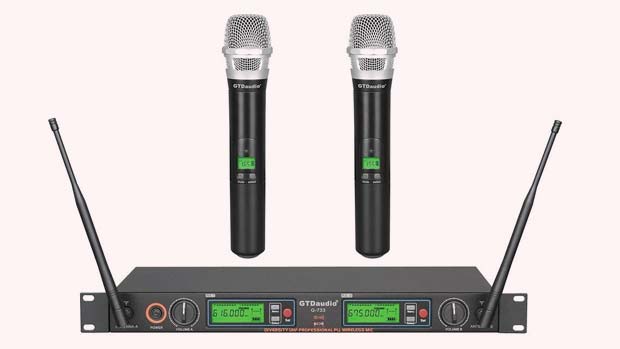
If you work in theater, or a place of worship, then you will be familiar with wireless microphones. In musical theater, you wouldn't be satisfied until you had one for every cast member, although for practical purposes there will usually be fewer. In places of worship, the common problem is that lack of funds has resulted in the equipment not being of the best quality. And of course the operator gets the blame for any problems it causes!
One thing a radio mic receiver must have to be considered of professional quality is an extra antenna. So as well as the necessary one antenna protruding from the box, there is another. What could it be for?
The biggest problem with wireless systems is reliability of reception. The transmitter, and therefore the transmitting antenna, is constantly on the move. You might think that as long as there is a direct line-of-sight between the transmitting and receiving antennas, then all should be well.
But no, there are reflections to consider. Radio waves will reflect from anything metal in the auditorium, which in a concrete building will be the steel reinforcing rods within the concrete. Buildings made from brick and wood are less problematical, but the problems don't go away completely.
Reflections interfere with the direct transmission causing a pattern of nulls that moves as the performer or worship leader moves. Occasionally there will be a null at the receiving antenna, resulting in a loss of signal, or worse still - breakthrough from another transmission outside the auditorium.
Having two antennas means that the chances of both being in a null at the same time are reduced. Such a receiver is known as a 'diversity receiver'.
Cheaper diversity receivers simply add together the signals from the two antennas. This means they only need one tuning circuit.
Better diversity receivers have two tuning circuits so that each antenna can be monitored for signal strength. The better of the two can be selected moment-by-moment.
One nicety in the use of diversity receivers is to separate the antennas, rather than having both mounted on the unit itself. Since the wavelength of a UHF wireless microphone transmission is typically somewhere around 350 mm, plainly the close spacing of receiver mounted antennae means that if there are reflection problems, both antennae could be affected by the same reflection.
So if one antenna is separated from the receiver, that is obviously going to be more robust. And if you're going to do that, you might as well place both antennae closer to the stage.
In professional theater it is common to place the receivers close to the stage too, so that the path from the antennae to the receiver is short. This obviously requires someone to be monitoring signal strength in case there is a problem since the front-of-house engineer will not be able to do it.
Wireless microphones truly are a wonderful invention. But it is not at all uncommon for audiences to hear the effects of their intrinsic problems. Taking the logical and necessary steps for reliable reception is therefore a necessity.

David Mellor
David Mellor is CEO and Course Director of Audio Masterclass. David has designed courses in audio education and training since 1986 and is the publisher and principal writer of Adventures In Audio.


