
Why active studio monitor loudspeakers should always sound better than passive speakers
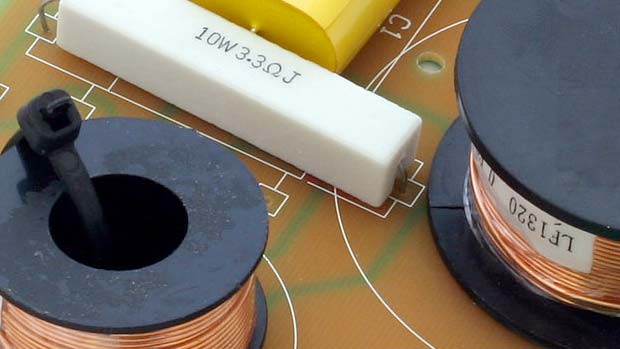
Most loudspeakers used in studio recording and domestic hi-fi are of the passive variety. This means that each channel of the power amplifier feeds high-level signal into each speaker enclosure. Inside the enclosure there is a passive crossover network consisting of resistors, capacitors and inductors that separates the signal into high frequencies (HF) which go to the tweeter, and low frequencies (LF) which go to the woofer. There may also be a midrange band.
The crossover is called 'passive' because it has no power supply and no means of amplifying the signal or any component of the signal.
Passive crossovers suffer from several problems:
- They must work at high power. This means using large expensive components, hence manufacturers will tend to simplify the circuit as much as possible
- Large inductors often have an iron core. This can saturate magnetically, causing distortion
- In practical crossovers, the sum of the outputs of the frequency bands is not equivalent to the input signal, hence the sound quality is changed
- The amplifier is electrically separated from the drive units, hence has less control over the motion of their diaphragms, particularly that of the woofer
An active loudspeaker can solve all of these problems. The signal from the mixing console is fed to an active crossover (which may be inside the speaker enclosure, meaning that the speaker has to be mains powered); the signal is split into frequency bands at low level, very accurately. Each band goes to a separate power amplifier, each of which is connected directly to a single drive unit.
The only apparent disadvantage of the active loudspeaker is that the need for multiple power amplifiers may mean that it is more expensive, but you don't need a separate power amplifier, so this will probably compensate.
However, it is not unknown for manufacturers to design so-called 'active' loudspeakers that are merely a passive loudspeaker with a single amplifier inside the box. This offers no advantage over conventional speakers.
The main reason why active loudspeakers are not more commonplace is that there is no separate power amplifier, and that means one less item for the manufacturer to market to eager buyers.
There is only one real disadvantage to active loudspeakers. This is in live sound where sometimes loudspeakers must be 'flown' (suspended). Obviously, an internal amplifier makes the speaker heavier, where with a passive system the amplifier could remain on the ground.

David Mellor
David Mellor is CEO and Course Director of Audio Masterclass. David has designed courses in audio education and training since 1986 and is the publisher and principal writer of Adventures In Audio.


