
What is Q? What can it do?

Ah, that mysterious Q control in your EQ. Does it actually do anything?

Here's an experiment... set up a track with some audio and an EQ plug-in. As you play the track, whack the Q control up and down. What do you hear?
Er, nothing? Did the Q control make no difference at all?
That's right. That's exactly what you should have heard.
So the Q control doesn't do anything then?
Well it doesn't do anything by itself. You have to set an EQ cut or boost first. Only then will you hear what the Q control can do.
So set an EQ boost. Nothing too extreme - 12 dB at 1 kHz should do. That should make things clearly audible.
Now play the track and whack the Q control up and down. What do you hear?
Probably something. But although the effects of the frequency and EQ gain controls are easy to hear. Q is more subtle.
The way to achieve familiarity with Q is to have a plan...
A low Q setting is generally more useful for making musical changes to the signal. If the balance of frequencies in the mid-range isn't quite what you want, set a lowish Q then experiment with the frequency and EQ gain controls.
As you can see, a low Q results in a wide band of frequencies being affected. This is a Q setting of 0.1...
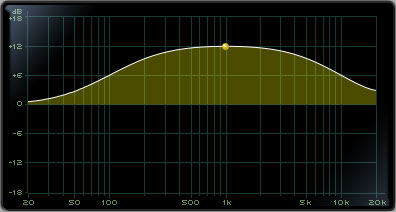
A high Q setting is more appropriate when there is something that is irritating you about the sound. Maybe there is an awkward resonance that is poking you in the ear. Acoustic guitars are often prone to this. You can set an EQ cut with a high-ish Q to take this out.
Sometimes you can use a high-ish Q to focus in on an individual instrument. For example suppose you have a band recording and there is some spill from the other instruments into the clarinet mic. You can set a boost with a high-ish Q and use the frequency control to focus in on the 'clarinetty' frequencies. This will push the spill further into the background.
Anything above 3 is a pretty high Q. This is a Q of 10. You would rarely need to use it this high...

A very high Q is more often used for EQ cut. If for example there is interference of a particular constant frequency in your recording, you can use a high-Q cut EQ as a 'notch' filter to reduce the interference without affecting anything else too much.

David Mellor
David Mellor is CEO and Course Director of Audio Masterclass. David has designed courses in audio education and training since 1986 and is the publisher and principal writer of Adventures In Audio.


