
The Focusrite ISA One microphone preamplifier review

The Focusrite ISA One certainly has an excellent pedigree. Its circuitry is derived from the Focusrite Forte mixing console, designed by the legendary Rupert Neve. Neve’s designs almost define audio electronics. So if the ISA One has a little piece of Rupert Neve inside, you can expect its sound quality to be impeccable.
The ISA One is a single channel device at a price that will only partially break the bank. It will accept a microphone line or instrument input. Clearly, however, its principal application is as a microphone preamplifier, so let’s take a look at that.
At the top left of the front panel is a gain control. This is not quite intuitive in operation. There is a switch to select a maximum of 30 decibels of gain, or a maximum of 60 decibels of gain. In the '30' position, the rotary switch can select 0, 10, 20 or 30 decibels of gain. In the '60' position, the rotary switch can select 30, 40, 50 or 60 decibels of gain. It’s interesting to note that there are two ways you can achieve 30 decibels of gain. That is the coarse gain control. Alongside that is a fine 'trim' control, which adds additional gain from 0 all the way up to 20 decibels. So we can see that the range of gain of this microphone preamplifier is from 0 dB all the way up to 80 dB, which should cover any possible requirement from the largest bass drum with the most sensitive microphone, to the ticking of a watch at twenty paces.
The other normal features of a microphone preamplifier are of course provided. There is a switch for 48 volt phantom power, a phase invert switch and high-pass filter. There is also a switchable insert point, so if the pristine sound of the ISA One isn’t quite to your liking, you can insert additional signal processing into the chain at this point. The most likely use would be for a compressor.
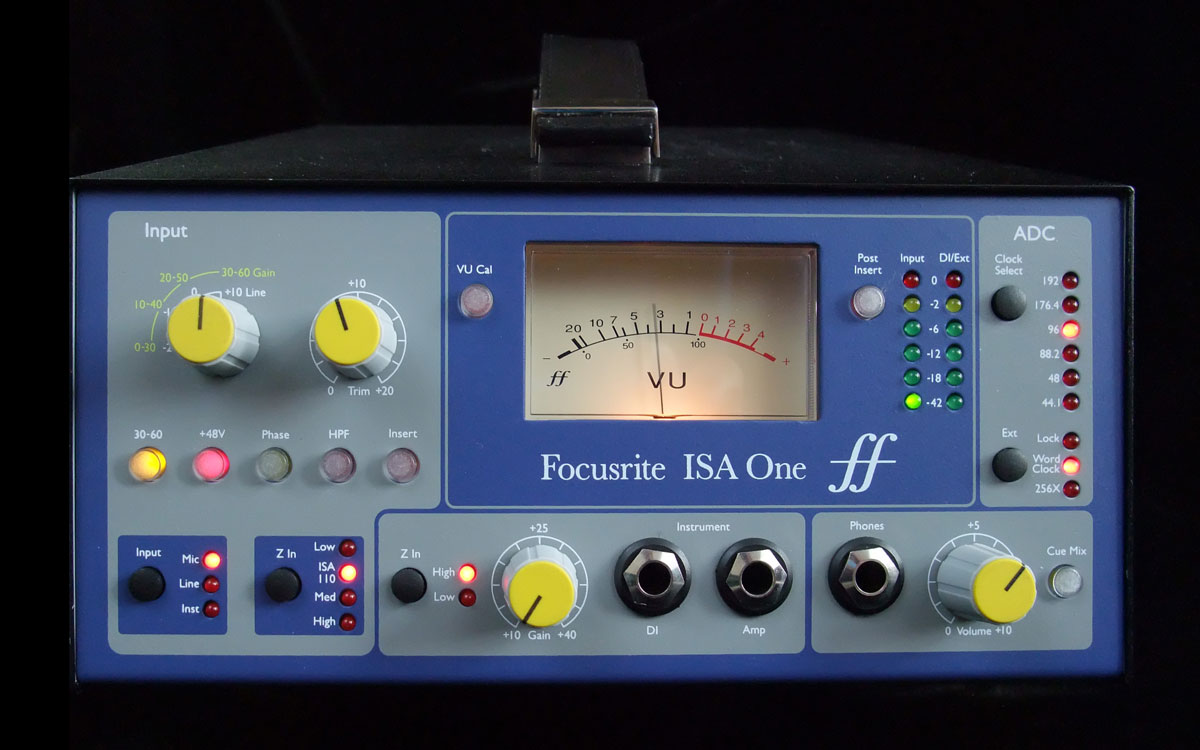
Now, as we know, a microphone preamplifier can’t just be a microphone preamplifier these days. It has to have something special or something additional to justify its existence, size and cost. In this case we have a variable input impedance which is labeled on the front panel ‘Z-In’, 'Z' is the normal abbreviation for impedance. This is a single button that can select 4 different impedances, indicated by red LEDs. The low impedance setting is 600 ohms. The setting labeled ISA 110, which is modeled on another piece of equipment in the ISA range, is 1400 ohms. Medium impedance is 2400 ohms. High impedance is 6800 ohms.
It’s worth asking the question why we need to have this switchable impedance. Isn’t there just one value for impedance that would suit all circumstances? Well, as Focusrite themselves point out in the manual, almost all professional microphones are designed to have a fairly low impedance output, somewhere around 150 – 300 ohms and you could consider about 200 ohms to be the norm. The reason why the impedance is lowish is firstly to be able to drive long cables without high frequency roll off due to cable capacitance, and secondly, it’s less susceptible to picking up noise. You could ask the question why can’t the output of the impedance of a microphone be even lower? The answer to that is in the limitations of the phantom power to supply the microphone with current. But 200 ohms in normal circumstances works just fine.
The next question is what should the input impedance of the preamplifier be? If you remember your school science, you might have learnt in the electricity lessons that you get maximum power transfer when the input impedance of an amplifier is the same as the output impedance of the device that is driving it, and this is indeed so. But, there is a problem with that. When we say that the output impedance of a microphone is 200 ohms, we are giving the value at around the 1 kilohertz point. At other frequencies, it is very likely that the output impedance will be different. This is particular so with microphones that use a transformer as the output and even more so with ribbon microphones. So, because effectively the preamplifier that has a low input impedance is imposing a different load on the microphone at different frequencies, this alters the frequency response of the microphone. It’s not going to damage the microphone in any way but it is going to extract a different kind of signal from the microphone than the designers intended. From this point of view, a low input impedance is not good.

Over time, preamp manufacturers have converged on an input impedance somewhere around 1200 ohms up to about 2000 ohms, which is still relatively low. This is not what you would remotely call high input impedance but it is high enough so that it is not unduly loading the microphone. The inaccuracy in frequency response caused by any kind of loading effect is minimized. So, if you feel that you would like to load the microphone even less and potentially get an even flatter frequency response, you might consider using the medium or the high input impedance settings on the ISA One. The high setting is not all that high, so you are not going to get into any trouble by doing that. It is purely what sounds best to you on the day.
As for the reasons for using the low input impedance setting, one reason for that could be if you had a microphone which had a particularly low output impedance, then it might be appropriate to use the lower input impedance setting on your preamplifier. To be honest, if a microphone has an unusually low output impedance, the designers of that microphone have gone against common custom and practice and they really need to explain in detail why, because the conventional output impedance of round about 200 ohms really has worked fine over a period of decades. The other reason why you might choose the low impedance setting is that the changes it makes in the frequency response of the microphone might just, in your situation on the day with whatever sound source you are using, sound better. So, it’s worth experimenting with this, just to see whether it sounds better to you. In truth, although it certainly is desirable to have equipment which is capable of a flat frequency response, very often it is simply what sounds better that is the correct way to go. The line input facility of this unit is useful and it works well, and other than that there really isn’t a great to say about it. So, lets move on to the instrument input.
This is intended for an instrument like an electric guitar. With a conventional electric guitar of the kind that doesn’t have an internal preamp, which is most of them, then the output impedance of the guitar pickup is pretty high. This means that it needs to be coupled to an input which has a very high input impedance, because even a medium input impedance will load the pickups too much. It simply dulls the sound and you won’t get the crispness you would hope for in that situation. So, connecting an electric guitar to a line input is not likely to produce good results. But here we have an input which is exactly right for an electric guitar. There are two impedance settings, a high setting and there is a low setting. Low is 300 kilo ohms, that’s 300,000 ohms, which is actually pretty high. High is 1 megaohm which is 1 million ohms, which is as high as you could ever possibly need, and the pickup is loaded to a minimal extent.

So, once again, you would choose whichever setting got the best sound from the instrument. There is a gain control on the instrument input and this ranges from 10 decibels to 40 decibels in one continuous rotary control. Changing impedance can affect level, but in reality it’s the tone that is more important here.
It’s interesting that this instrument input can be used independently of the microphone line input and you can be using the ISA One as a microphone preamplifier and at the same time be using it as a DI for an electric guitar. That is a feature that some people could find useful.
Over on the lower right of the front panel of the Focusrite ISA One, we have a monitoring section which is intended for headphone monitoring. There is a choice here - you can either use it to monitor the output of the preamplifier, or there is a button to select cue mix. With cue mix selected, then you can apply a signal from your digital audio workstation to the cue mix sockets on the back and this is the signal which will be fed to the headphones for monitoring by the performer.
It probably won’t have escaped your notice that there is a fairly large VU meter on the front panel of this piece of equipment. You could ask the question here, what is the function of a VU meter in this context? VU meters are notoriously inaccurate. They measure steady state signals very well, but for a signal which is impulsive, even in the slightest, the meter is not fast enough to respond accurately. Therefore it will under-read on peaks. So, in general, the VU meter is not a very good measuring instrument. However, what the VU meter is good at is telling you that something is going on. So, if there’s a signal going into the preamplifier and the VU is twitching, that means all is well. Other preamps may have a signal-present LED which is useful too, but my preference would be for the VU meter. I could live without it but hey, I can live with it too. To supplement the VU meter there is also a small LED bar graph with just six steps. Even so, that will tell you your peak level. So, it’s like having the best of both worlds.
The Focusrite ISA One has an optional digital output. So without the digital output this is just a conventional preamp and you will connect it to your audio interface, or analog to digital converter. But, you might think that since you’ve gone to the trouble investing in a quality Focusrite product, with Rupert Neve-influenced electronics inside, you might prefer to leave the analogue digital conversion to Focusrite. There would be strong grounds for believing that Focusrite would be able to optimize the A-D conversion to the requirements of the preamplifier. So, if you choose the digital output option, then you will be able to digitize the signal inside the ISA One to a resolution of 44.1 kHz, 48 kHz, 88.2 kHz, 96 kHz - and here are the biggies - 176.4 kHz and all the way up to 192 kHz for the ultimate in audio quality. Naturally the unit will sync to a variety of clock sources.
Now, you may have seen some of the marketing materials for this preamplifier and you will find that there are two things that the marketing plays on. One is the use of a Lars Lundahl transformer on the input of the preamp. Why is the transformer important? Well, going back in history, all microphone preamplifiers of professional quality used a transformer on the input.

Gradually, over a period of years, components became available that allowed transformerless preamps to be designed, and eventually they reached the same level of quality of transformer-based preamps. Some might say they potentially exceeded the ability of a transformer based preamplifier. So, what we have here is a preamp which effectively harks back to an earlier era of preamplifier design. There is every good reason for having that transformer in there, because it is a principal part of that circuit and I am quite sure that Rupert Neve wouldn’t have it any other way. Why is it a Lars Lundahl transformer? Well there a number of manufacturers of transformers and Lundahl is a prominent manufacturer. I’ve used Lundahl transformers myself and I know that they are very effective.
In a circuit that is properly designed, the effect of a transformer on sound quality should be negligible. If you can hear the transformer, then that is a sign of a bad design, or it might be a sign of a design where you are intended to hear the sound of the transformer. There is something to be said for that. In the old days of audio electronics, we couldn’t get away from transformers and we so longed to have a transformer-free signal chain, considering that in the recording process, a signal could go through 10 or 20 transformers through its lifetime. But, now we have a choice. We can choose a preamp which doesn’t have a transformer, or you can choose this preamp which does.
The other interesting feature that the marketing for the ISA One mentions is the bespoke Zobel network. Amplifiers of various kinds, large and small, are often troubled by the load that you attach to the output. So, the amplifier itself might behave perfectly well and reasonably but then, if you attach a tricky load (or no load) to the output, the amplifier could start oscillating. If you’ve ever experimented with electronic circuitry, you can easily experience this. So what we ideally want is to protect the output to the amplifier so that you can connect any load to it, however unreasonable, and the amplifier will not oscillate. This is the function of the Zobel network. So the Zobel network is actually quite a common thing. It could in theory affect the sound quality. I think we can expect here that Focusrite has taken the trouble to ensure that the Zobel network matches the intrinsic sound quality of the other components of the preamplifier.

Ultimately the $64,000 question is what does this preamp sound like? The principle defining feature of the sound of this preamplifier is its cleanliness and clarity. If you want the preamp to respect your sound source, whether it’s a microphone, a line input or an instrument, then this is the preamp that will do that. This is not, in my opinion, a 'personality' preamplifier. This is one that takes the signal as it is and does what it has to do with it, without adding anything and without taking away. If you want a preamplifier to have character, then you should probably be looking at a vacuum tube preamplifier because the ISA One most definitely isn’t that. But then, with a vacuum tube preamplifier, along with the supposed warmth that you get, you will get distortion. Sometimes warmth can be superficially pleasurable, but ultimately the effect of the distortion component of the signal quality can become tiring. But not with the Focusrite ISA One because it takes the signal as it is and amplifies it. That’s what it does. Also, if you have a really good vacuum tube microphone, there is a strong argument to say that you really ought to keep the signal as it is. What would be the point, for instance, of using a vintage U47 microphone and plugging it into a vacuum tube preamp? A vacuum tube preamplifier is going to change the sound of the microphone and the sound is why you chose the microphone in the first place. So, if you have a really good microphone, the chances are you will get a better quality of signal by using a preamplifier such as the Focusrite ISA One. In fact, I would go as far to say that if your microphone isn’t so good, then that is when you need the vacuum tube preamplifier.
In summary, this is an excellent product. It’s exactly what you would expect from a high quality Focusrite preamp. The price is reasonable and you will be fully satisfied with your purchase, I am sure of that.
You can hear the Focusrite ISA One in this video...
Comments on this video
You can comment on this video at YouTube
You can comment on this video at YouTube

David Mellor
David Mellor is CEO and Course Director of Audio Masterclass. David has designed courses in audio education and training since 1986 and is the publisher and principal writer of Adventures In Audio.


@Victormormusic: UA all day
@Aaa-pz6nh: 610 sounds more pleasing
@704_t_a_y: I got the ISA a few months ago and I love it. Very clean accurate sound. I’ve used it with budget and higher end mics alike, and it always makes the vocal shine regardless of the mic.
@Liftedtrucks909: ISA really doent have a bottom to it, not sure how that would sound in the mix
@Liftedtrucks909: I am building a small record studio in Louisiana. Strictly urban street music, hip hop RNB. Will be tracking with a U67 Reissue into ISA 430 Channel Strip ! Loved the Focusrite so much.
@Joseph124269: I would like to know what kind of mic was used, because that's where the sound quality begins with.
@bukowskimoho: Uad sounded better in this voice, listen to the Ss, on the isa pre are ear piercing
@gilsondigue29: This song is painful to hear
@QuantizStudioRecords: UA has more body in details
@RobHarrison: Liked the 610 for musicality but would love to know if the ISA is sonically more true to the input. Shame I can’t hear the singer in the room. Was gonna buy the Focusrite but now not so sure.
@billesposito2112: The ISA sounds less compressed to me. Seems like the UA has some natural compression. Is that from the tubes?
@chrismcdermottmusician: The UA at high gain has a nice natural compression happening from the tubes.
@faserpelz9277: Eight years later :-) from a hobbyist, listening with an AKG K702 headphone... In my opinion, the UA with low gain sounded best for me, round and smooth with nice dynamics. With high gain I heard compression, and the song looses feeling, for my taste. The ISA forwarded everything, what the microfone catched, I assume.
I would prefer the UA with low gain for a song with the voice alone. In the mix with other instruments you have to choose differently, maybe. But if I could get the sound of the UA, with the ISA connected to a soundshaping unit, I would choose the ISA.
Thanks for the comparison.
@ns1983za: What a great comparison! I love how the ISA brings out the lightness and sweetness of this song.
@adkywun: Very noisy and cracked sound on the UA. Where's the room reverb are from? If I must say, the ISA is more properly setup but sorry It still not good. BTW, the ISA ONE is not a transistor based preamp, It is Transformer input IC-opamp design preamp. I hope you don't mind. Thanks for the video.
@pianolover5417: Isa one preamp was the only right Decision I made in my entire freaking life! 😁 I use it with neumann tlm 102 and a 1176 compressor!
my vocal sound is way better than many studios!
@Robbielacruz replies to @pianolover5417: Cual preamplificador tienes ?
@OllertonMD: I think this is one of the best videos for beginners to see the differences a preamp can impart on the sound. All preamp comparison videos should be this organized.
The 610 setting 1 is somewhat vibey and vintage, but second setting where they crank up the tube gain stage really shows what a tube can do to the sound. Smooth, warm, high end rolled off. Very vintage.
Focusrite is pristine, airy, open.
It also shows that no preamp is better than another. The 610 might be awesome for folk music and the Focusrite might be much more appropriate for pop or a very intimate, high fidelity modern sound.
@estrelasdetopázio: To my ears listening in a treated room on studio monitors and also on Beyer DT 770 pro headphones. I felt the 610 sounded rounded and had a pleasing tone overall. The isa one pre revealed more detail and sounded more present. For me there is no right or wrong therefore I'm glad that I own both pre amps. I feel its is best to have both flavours in my opinion.
@omdwillieturnip8840: The isa one is SO sibilant!! Holy crap
@szunabass: Design describes the sound... :) Genial products both. Vintage vs. modern.
I've worked on both as bass player.
Cannot decide, like both.
@danielwhynter: the vox has reverb at first then with the focusrite the vox became dry....please explain
@AudioMasterclass replies to @danielwhynter: What you are hearing are the recordings direct from mic to preamp to DAW with no processing. The levels were set in the session and there are small differences between the takes. If the takes are normalized to the same RMS level then the balance of studio ambience is very similar. It should be borne in mind that even with tape markers on the studio floor there may be small differences in mouth-to-mic distance from take to take, which will affect the balance of studio ambience. DM
@ISLANDVISUALS309: you jus helped me figure my pre amp out thank you soo much i needed you
@AudioMasterclass replies to @ISLANDVISUALS309: You're welcome. DM
@ettiennelane9173: ISA One!
@zachjarrett8730: What mic was used?
@AudioMasterclass replies to @zachjarrett8730: The microphone is the sE Electronics 4400a set to cardioid pattern. We have recordings made with other mics in the Audio Masterclass course https://www.audiomasterclass.com/music-production-and-sound-engineering-course/
@ClaraEvaMedvesan: Focusrite is less from all perspectives..sorry.
@thedayones4918: What is that hight pitched sound on the vocals 10k or so 😎
@enricotrafeli4425: Universal Audio Solo/610 like it
@rdhorsey9081: I was hoping to hear some shorter vocal segments with singers who have powerful and full-range voices - singers like Aretha Franklin, Ann Wilson, Jackie Wilson, or Chris Cornell.
This featured singer, and song choice, were very difficult to listen to and offered me very little in terms of dynamics or range!
@vincenteoppolo9025: I own these 2 units ... the 610 on my vocals and as a DI. The Focusrite handles acoustic instruments
@hanashe4599: That song was rough to listen to, but it was a good comparison. I like the UA 610 much better. But tube warm and feel is hard to beat for leads. The Focusrite sounds good, more detailed, but colder. Which is nice for some things. I could see using it too, but I get it's sound very similarly in plug-ins.
@secretsoffireband: UA sounded quite heavily saturated. FRite sounded clean.
@maldonadocorrea: que excelente video, felicitaciones. que microono utilizo en la prueba?
@AudioMasterclass replies to @maldonadocorrea: The microphone is the sE Electronics 4400a set to cardioid pattern.
@maldonadocorrea replies to @maldonadocorrea: Audio Masterclass muchas gracias. Excelente video👏🏻. No logro ver bien las ganancias en la isa one. Suena muy bien 👍
@jeffroberts_tunes: wow both are unbearably sibilant
@rt-uh6mt: I think on female vocals that ISA is definitely what you want.
@AudioMasterclass replies to @rt-uh6mt: Thank you for your comment. We love to hear viewers' opinions.
@A4R4N4: Can u downlod this butterfly song from somewhere , i like it .
@AudioMasterclass replies to @A4R4N4: https://youtu.be/QdU7dNt-1Es
@A4R4N4 replies to @A4R4N4: @AudioMasterclass u guys were fast . thanks ... any further music related queries , ill hit u guys up .tc
@russellbirch5224: The mic and the room sound terrible.
@AudioMasterclass replies to @russellbirch5224: The mic is the sE Electronics 4400a set to cardioid pattern. The room is Abbey Road Studio 2.
@donjohestudiopost-producti9161: Hi guys
Thanks for the video. Interesting shootout.
I’m lucky to own both. I love them both, but I use them very differently and each of them with selected microphones. Some microphones sound excellent with the UA 610/Solo AND the ISA One, while others not sound so good with the UA 610/Solo, but shines on the ISA One. And again, it also depends on the vocalist and genre. I love to use the UA 610/Solo on thin male or female vocals when I produce typical singer/songwriter material, with maybe just a piano, western guitar and a bass. The UA 610/Solo brings the vocal nicely forward with a warm natural and soft character, while I seldom would use the ISA for that kind of job, but again - it depends on so many things.
I am also curious what microphone is being used here?
Cheers
Don
@AudioMasterclass replies to @donjohestudiopost-producti9161: Thank you for your detailed comment. The microphone is the sE Electronics 4400a set to cardioid pattern.
@vahidsaberi251: Absolutely Isa one was better than UA
@hoodedman07: High gain and low output is so much better
@derekec: I don't know what's wrong with me.. I try like nuts and yet I can't hear a difference.
@AudioMasterclass replies to @derekec: There are more detailed demonstrations in our course materials. However in summary the UA is a tube preamp with both gain and output controls, meaning that you can vary the amount of tube warmth. The Focusrite is more orientated towards accuracy and you can set the input impedance to match the needs of the mic. However, you can use the input impedance to get subtle variations in sound texture. It's harder to hear than in the UA but still worth experiencing. One more thing - You need to be listening on studio-grade monitors or headphones or the difference will be very difficult to hear.
@mikeslay3294: Great demo, through my head phones I like the UA with a bit of drive, but I’d imagine the 428 would sit in a mix better. The top end is just cleaner and more focused on the ISA.
@rylieriley: I love the warm sound of the UA preamp, but the Focusrite pre is so clean and clear. I love them both, really.
@derrickchapman8504: What audio interface you using or converter
@AudioMasterclass replies to @derrickchapman8504: Abbey Road's Prism converters https://www.prismsound.com/
@johannmuster9726 replies to @derrickchapman8504: there we go, if you got the money almost everything would sound great with a prism
@billstotts2346: Really good comparison. On most audio demos, I can't really tell the difference as well as this video. I am a sax player and I never play without my UA solo 610. I love high gain and mid output and stand back from the microphone. It's a bit of money, but worth it to make the audience jaws drop.
@AudioMasterclass replies to @billstotts2346: Thank you for your comment. Although not the only preamp with this feature, the option of balancing gain and output is a wonderful way to explore the classic sound of vacuum tubes.
@mauricioa.garcia4684: The ISA for me sound more better sweet Sharp for less money
@williamklimek9676: hi, i am from Chicago area. it sounds funny to my ear when you say "vacuum tube preamp'. perhaps you should just say 'valve', I think we all get it by now.
@AudioMasterclass replies to @williamklimek9676: Thank you for your comment. We consider such style issues from time to time but in this case the word 'valve' has multiple meanings, 'tube' has multiple meanings, but 'vacuum tube' is generally understood to mean only one thing. To be more precise, we could say 'thermionic tube' but that's probably going a stage too far. We appreciate your input however.
@MusicCityWorld: I am use isa two in our studio. isa is sweet vocal preamps just like neve.
@montag4516 replies to @MusicCityWorld: Also excellent for getting tight, snappier sounds from kick drums and snares. It a very handy, pro level preamp. I tried the UA preamp shown here as well. Another quality product but it didn't offer me results that I wasn't already getting elsewhere.
@derrickchapman7283: What about the focusrite isa one digital card your thoughts like is it worth it what about the converter
@AudioMasterclass replies to @derrickchapman7283: My opinion is that if you're going to use a separate preamp and not the preamps in your mixing console or audio interface then it makes logical sense to get the digital card and avoid using the analogue line input of your interface. But the extra cost is somewhere around $300 - $400 depending on where you buy and there may be other elements of your studio setup that could benefit more from this level of investment. DM
@gkiss2030 replies to @derrickchapman7283: @AudioMasterclass I intend to run the optical line to my UA Twin X, bypassing the built in preamps. Doing so, though, must forfeit the use of Unison feature (as the impedance is not a valid argument in case of optical)?
@AudioMasterclass replies to @derrickchapman7283: @gkiss2030 Giving this my best guess, until microphones have optical outputs I think you're probably correct. You must be using something as a mic preamp though; something with an optical output? I suggest that your most reliable answer will come from Universal Audio support. DM
@gkiss2030 replies to @derrickchapman7283: @AudioMasterclass Yes, and that would be the ISA One. Thank you!
@keithrowe1007: SSSSSSSSSSSIBILANCE! Vocalist was obviously singing very quietly for it to be that esssey. I'm guessing her low output is also why the tube hardly saturated at when input was turned up?
Either would do the job. But ...ISA does one thing really, really well - a nice clear signal. 610 also does that thing really well (notice only one 'really'), but it also does a bit of tube saturation.
I'd lean toward the UA because I always like more options. I suspect that a vocalist with a hotter voice, or a drummer, or a cabinet, would probably saturate the tube more.
Maybe some of you learned folk out there know: can you get a transformer to give out interesting harmonics and saturation by hitting it hard like you can with a tube?
TTFN
Keith
@AudioMasterclass replies to @keithrowe1007: Thank you for your comment. One person's sibilance is another person's interesting sound texture and I don't mind this. Regarding level, yes more level at the input will give more saturation, and of course so will more gain. This isn't an ultra-saturatey preamp (there's a new word for the dictionary) but it definitely does have a texture and is well worth a try. DM
@shaft9000 replies to @keithrowe1007: Because the 610 has a large gain range well over 60 dB, it is designed to maintain at least halfway-decent headroom at high gain ~before~ it hits the compressor.
Saturation (in the form of THD ) is a result of failure to maintain linear response and headroom in the circuit, like most forms of distortion.
@JohnnysaidWhat: the UA has a smooth low mid character. The ISA is also smooth but in the high mids. It's hard to avoid buzz words like "warm" for the UA and "transparent" for the ISA. The magic for me is how the UA manages to be warm on the low to low mids while still retaining clarity. It has dimension I prefer for more emotional personal introspective styles of music that just take you on a nostalgia trip. The ISA would work for more of a musical on broadway sound or upbeat fun style of recording. I think they are both amazing pres that do different things very well. Wish I could get both of them! Maybe one day =)
@guillsocial: i listened with headphones and UA is better more warm and less bright but with headphones the sound change.
@MonstarMk3: Listen to the "S's" as well. They are swishy on the UA, but the sound is darker on the UA. The Focusrite is brighter and crisper, but the swishy S's is there, but not as bad as the UA. That says a LOT!
@MusicCityOdia: I am use focusrite mic pre in our studio
@maldonadocorrea replies to @MusicCityOdia: Music City Odia acabo de comprar una . Y uso un Rode nt1 , como la usas tu ?
@ashenone3427: I really like both. I would love to own both. But , the one thing I like about the Focusrite is how accurate it sounds.
@bigxrecords7375 replies to @ashenone3427: Just buy it
@larrytate1657: Focusrite for me
@tgletgle9980: not a huge difference, both nice enough and either one would be fine with this track
@himitsuvoice: ISA ISA ISA ISA ISA ISA
@oboreal69: Damn god, why so much sibillance ? None of this records are close to good...
@portwill replies to @oboreal69: Agreed, I am surprised about that too
@timtallentmusic replies to @oboreal69: Cause it’s raw no post processing, is my guess. Natural sibilance in her voice plus a condenser with higher frequency boosts brings that out. It’s more work than we’d like but It sounds like it would take eq nicely .
@TaiChiRehab: Love how he says the difference is there if you listen out for it....
WTF .... If you listen out for it.
@orangemaniabrother2232 replies to @TaiChiRehab: Yeah, crazy you gotta use your ears for an audio test
@donallfinn: the 610 with the gain cranked doesn't add even close to the amount of new harmonics that I would expect
@donallfinn replies to @donallfinn: It seemed to make the vocal darker rather than adding color, that color would be my entire reason for buying one so that's a letdown. I don't understand manufacturers like Avalon who try and make transparent tube pres, if they are trasparent then whats the point?
@thebigvoro replies to @donallfinn: they are "transparent", right. But not neutral. Sometimes I even re-recorded my mixes thru an Avalon pream an it changed a lot and gained quality...And I think that the main point of the Avalon is a compressor, that combined with the amp gives great output sound...
@shaft9000 replies to @donallfinn: @donallfinn Clean high-voltage tube circuits (running the correct tubes)
are very different animals in comparison to the commonly intentional "tube distortion" you get when running a cost-effective chinese AX7 on a modern, efficient, low-wattage power supply. Obvious breakup and distortion is the usual goal here, so the circuit designer may intentionally choose a lower quality, cheaper tube (or another part spec) than what is technically prescribed because "some tube distortion" is often the goal in many of the cheaper boxes.
That's about all I can tell you, the rest is a matter of using them and finding out for yourself.
@WizardsMachine: My mic guess: U87 (?)
@lumpyfishgravy: There should be a health warning before playing musical theatre. At least a countdown so I can vacate the room.
@ourcollectiveinsanity: no clear winner here, but maybe the big box sounded slightly bbetter with her voice, but not by much
@JohnAudioTech: The 2nd sample sounded worst to my ears. Also, the vocalist has an annoying high frequency tone to her sibilance.
@JuriJurgen: на ONE DAY тёлочка лагает)
@rayupov replies to @JuriJurgen: ахахахах, когда зашел в комменты почитать что "профы за бугром" рекомендуют, а тут))))
@enriquedelapaz7002: The ISA is a total winner for me
@djentlover replies to @enriquedelapaz7002: Weird, with my headphones the ua sounds infinitely better
@oysteinsoreide4323 replies to @enriquedelapaz7002: The UA won it for me, and I'm listening with Sennheiser hd 650, which is quite detailed in the mids. I liked the low gain high output best, but of course it depends how the song is going to blend into other instruments.
@maldonadocorrea replies to @enriquedelapaz7002: Enrique De La Paz acabó de comprar una, estoy tratando de darle el
Uso correcto. Hago VoiceOver uso un Rode nt1
@morningamps3879: But do they really use that crap at their studio?
@rt-uh6mt replies to @morningamps3879: So a Bill Putnam designed preamp is crap? Rolling eyes.
@morningamps3879 replies to @morningamps3879: Rolling yet moving.
@G_handle replies to @morningamps3879: b. t. Bill Putnam Versus Rupert Neve
@uelude: I never want to hear that song again in my life.
I feel sorry for the engineer who had to hear that on repeat! :-O
@ruthlesscutthroat replies to @uelude: fuckin hell mate
@xdeadyoungx replies to @uelude: Lol
@ctrlaltcreate3827 replies to @uelude: Wild ass comment 😂
@shaft9000 replies to @uelude: DAAAAAA-uh-AAAAyyyyyyy....
@Aleksander_Nilsen: I think she's singing about the focusrite.
@yannicguenthermusic replies to @Aleksander_Nilsen: definitely
@mikewalker3337: So this vocal was created at the same studio that recorded the Beatles and Darkside of the moon...OK..sure.
@rt-uh6mt replies to @mikewalker3337: What? Yes. Abbey Roads has about 7 or 8 studios now ... Studio Two is where that classic stuff was recorded, I'm sure this test was done in one of the newer, smaller, cheaper studios of theirs but yes it's all "Abbey Roads." But truth is they could have recorded this in a nice home studio and it wouldn't have made too much difference on this.
@hopeindope9757: I don't know it looks to me that give more gain reduce the dynamic is this possible?
@RasimMAG: .....a microphone you used in this test?
@tgletgle9980: the UA sounded more lively, the ISA prettier and warmer.
@davidhillshafer3646: Best thing to do is have them both, they are great, affordable preamps with real character! I have them both and can say for sure these are untreated samples. Was interested in picking up the converter card for the ISA One and was wondering if you have experience with it? If so, how does it compare to the Prism ADA-8 used here? Thanks!
@CaryMillerOfficial replies to @davidhillshafer3646: Nothing is going to beat Prism units. We picked a Prism Titan via Digilink to PTHD Native this last year after trying just about everything on the market, including the Dream and ADA-8Xr (which was in our top three choices with Classic 96 converters by IZ for RADAR/ADA II systems). I'm sure the card is passable, but it's not going to sound as nice as an AD/DA loop on a Prism. Loved the ADA-8Xr, but it the Titan wins by a hair with delay compensation at high sample rates via PTHD. Still...not much out there can compete with your ADA (we really did try just about everything on the market at the time).
@beku73: UA 610 sounds warmer. Isa is more transparent. The difference on preamps today is very small especially for normal listeners.
@MythHealer: Female vocals need the drive from the UA 610.
@muriloninja: I liked the Focusrite ISA, I just bought one today so there is that but I know nothing of it really but this to my ears seems the Focusrite ISA was a good choice for me
@therealkendallwiltz replies to @muriloninja: Same, for some reason I felt like the vocals with the focus rite sit in just right and upfront
@holymonkeybeats: ISA Only
@johnjosephsmith73: Her voice is great but the song is that shit it's hard to distinguish what's good or bad :-/
@nilaghkcghnc103: just uad
@Das4real36: The UA had a more rounded sound quality while the ISA had more of an sharp clean sound to her vocals. The differences between vocals were night and day, it is like you are comparing Tube transformers to solid state transformers. that is going to raise flags and make you wonder.
@TheDoug2103 replies to @Das4real36: my point exactly, in heard the exact opposite. its all subjective.
@michakupicz5680 replies to @Das4real36: it's the other way around dude, UA is sibilant and thin
@Aaa-pz6nh replies to @Das4real36: @michakupicz5680thin? It’s way thicker than the ISA
@blancodeplomo: ISA
@ray1ashwin: ua sounded lot smoother n focusrite sounded vintagey.both are great units.
@Eliellazo: ISA
@chiefkitsapacademy2464: focusrite is the better pre. isn't it modeled from 1073
@Malikshamsid replies to @chiefkitsapacademy2464: +Chief Kitsap Academy
No, it isn't.
@darty58 replies to @chiefkitsapacademy2464: It's an adaptation of the focusrite ISA 110 module that equiped the Studio Console designed by... Ruppert Neve so yes, there is 1073 inside
@shaft9000 replies to @chiefkitsapacademy2464: ISAs share ~some~ similarity due to being designed by the same man ~20 years apart.
But not enough to be closer than 3rd cousins separated by several "divorces" over two decades.
@67Stu: I've done a side-by-side with these two products. I can tell everyone here with absolute certainty that this test is as you hear it: nothing added!
@DahoodShaheed: Would be great if you could tell us what converter you used. Thanks
@AudioMasterclass replies to @DahoodShaheed: +Dahood Shaheed Prism Sound ADA-8
@DahoodShaheed replies to @DahoodShaheed: +Audio Masterclass Thanks for the info, must say im impressed with the converters pristine reproduction.
@CesarLimaYoHomeboiJuliusC: I enjoyed the low gain and high output on her on the 610 and the isa one sound, the bigger sound did not fit her voice with high gain and low output but i can see other genres taking advantage of this. not sure if she was closer to the mic on the isa one but her voice sounded bigger or closer to the mic on the ua than the isa one. were the converters different on both units or did you use the same converters for both takes? and thanks for making this video, been wanting to hear a comparison between the two. if you can do a comparison on male vocals please do!
can you go over the impedance changes on the isa one and how that would affect the voice?
@MrRoberacer replies to @CesarLimaYoHomeboiJuliusC: I found with the ISA that the high frequency lifted area of the mic was more obvious at a lower frequency which I was not really fond of. The only time I heard a 610 previous to this I think had tired tubes or something in it. It was very unimpressive. Thin sounding. So much so that I ended up going with the console's pre (I can't remember what it was, maybe a Midas H3000?) but would have been a good one anyway. I liked the 610 left with the output section used to gain up the mic. It took on a lot of air which on her voice and commonly is nice. I might have had to tone it down on mix down a bit but I would rather have it already then be trying to manufacture it. Is the output section tubes as well?
@RealBreakBreadFilms replies to @CesarLimaYoHomeboiJuliusC: I've owned the isa one for 2 years now and I must say, it's bright AF but I love it
@stillphil: 0:48 UA butterfly
3:09 Focusrite butterfly
1:19 and today could be that UA day
3:40 and today could be that Focusrite day
1:44 if I only had one UA day
2:56 if I only had one UA day (second setting)
4:06 if I only had one Focusrite day
@cityz3n replies to @stillphil: thank you so much!
@aramism.5548 replies to @stillphil: You‘re a hero.
@orangemaniabrother2232 replies to @stillphil: Thank you, perfect
@Liftedtrucks909 replies to @stillphil: Wow. The Focus rite has significantly more dynamics.
Do you think the 610 would work better for hiphop because of this?
@ramonfelizjr replies to @stillphil: Thx
@PsalmMiracle: I'm an audio engineer, I hate when engineers like yourself sell these people dreams, I know forsure that she's been eq'd there alil slap delay also a tad bit reverb pretty sure studio affect, please show the true sound of this unit without plug-ins. in there's alot more to get that sound than just a pre, tell the truth thanks
@brentvalleywhag3477 replies to @PsalmMiracle: Also an audio engineer. Can clearly hear that there is no slap delay. As for the verb, there's no way to conclusively tell if that is in fact added reverb or just the room. One thing is for sure, there is far more headphone bleed in the 610 examples which you may be confusing with an effect.
@AudioMasterclass replies to @PsalmMiracle: We can confirm that there is no processing in this recording. You hear the singer, the studio, the mics and the preamps, and - if you have really keen ears - the converters. That is all.
@beakf1 replies to @PsalmMiracle: +Audio Masterclass are you using the abby road converters or the built in isa one converter. If not what did you use?
@DahoodShaheed replies to @PsalmMiracle: +Psalm Miracle, i can clearly hear some trails, perhaps its the room.
@bd-onebeatzz8296 replies to @PsalmMiracle: U right psalm miracle
@anthonycolon8148: What microphone you use for this 2 preamps?
@Prinx6 replies to @anthonycolon8148: Anthony Colon good question
@AudioMasterclass replies to @anthonycolon8148: Apologies for the delay. It's the sE Electronics 4400a set to cardioid pattern.
@Angelo-vb6dg replies to @anthonycolon8148: @AudioMasterclass "for the delay"
@chinosofer replies to @anthonycolon8148: @Angelo-vb6dg :D
@lukesuperflyjones: Good shootout!! These were all taken on the same take correct?? I liked the first take of the 610 and the isa take. In some ways it would be nice to have both to work with! What kind of mic was used!?
@AudioMasterclass replies to @lukesuperflyjones: Apologies for the delay. They are different takes. We could perhaps have used two Solo/610 preamps and the ISA One with a three-way splitter, but that would create another variable that isn't in common use. The microphone is the sE Electronics 4400a set to cardioid pattern.
@lukesuperflyjones replies to @lukesuperflyjones: @AudioMasterclass ahahah wow. well I guess I'll wait another 5years to have another question answered ahah thanks for getting back though ahah
@Anamoly_: Are all your examples in your tour videos unadulterated?
@AudioMasterclass replies to @Anamoly_: Nitsua Nox Enrolled students have access to the original studio master recordings. For our videos here on YouTube they are converted to AAC without any other processing.
@Anamoly_ replies to @Anamoly_: How thorough is post production covered in your course?
@AudioMasterclass replies to @Anamoly_: Nitsua Nox Would you please direct your question through the contact page at http://www.audiomasterclass.com. We will be able to help you in detail there.
@roland1313: Also interesting to the upper mids, and how the UA tends to scoop them a bit, whereas the ISa seems to accentuate them..IMHO