
Redundant design protects against live sound system failure
Probably the worst thing that can happen in audio is for equipment to fail in the middle of a live broadcast.
Actually it's not, because the broadcaster will cut to something else. And although there will be a subsequent enquiry, it's not as though viewers will storm the station.
But in live sound things are different. If your equipment fails, there could be 2000 people in a theater turning round to look at you. In an arena, maybe 15,000. In an open air concert, up to 200,000.
Imagine that - 200,000 people looking at you - blaming you - because your equipment has failed.
So to protect against this scenario, obviously live sound equipment is designed and built to a high standard. But then there are further protective measures...
A compressor or EQ can be designed so that if it fails, it can be switched off. Switching it off connects the input directly to the output through nothing more than wire. Obviously there is no compression or EQ and the level will change, but at least the signal is still there.
A mixing console can be fitted with two power supplies so that if one fails - and power supplies are prone to failure - the other automatically takes over.
Some mixing consoles, such as Cadac, are designed so that channel modules can be hot-swapped while the show is running.
Digital equipment however has other worries. Digital equipment can crash.
Even today, it is impossible to fully verify a digital system, beyond any but the simplest, to be sure that its output is predictable under all circumstances of input.
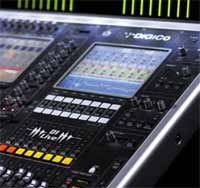
But, for example, Digico have designed their consoles so that two can run in parallel. The operator's input to one will be mirrored on the other via an Ethernet connection. And if the live console fails, the backup is switched in.
Likewise, Digico use a fiber-optic 'ring' for data transmission.
This is like a ring main in domestic electrical supply. The electricity can travel in both directions around the ring, saving on the amount of copper that needs to be used.
In a fiber optic ring however, the cable can be completely cut - sliced through with an axe - and the system will still work. This is because the cable is still connected through the other side of the ring.
So now even digital live sound engineers can have a feeling of security. (Until the singer drops the mic and the backing tape plays on...)

David Mellor
David Mellor is CEO and Course Director of Audio Masterclass. David has designed courses in audio education and training since 1986 and is the publisher and principal writer of Adventures In Audio.


