
Q: How should I time correct multiple microphones?
Here's the question...
"The setup is for classical music. My recorder is an ADAT Â HD24 with EC-2 card. There is a useful track slip function by which audio can be delayed or advanced during playback.
"My question is how to set the right delay or advance? The Decca Tree middle mic is 2 feet from the stereo pair (Decca Tree) so the delay is -2 ms. The piano bass mic (under the piano) is about 8 feet from Decca Tree and the delay is -8 ms. The vocal mic is 16.6 feet from the stereo pair (Decca Tree) and the other side of the piano 10.3 feet from piano.
"If I set the delay to -16.6 ms I hear double piano sounds, especially in the higher notes. If I set the delay to -10.3 milliseconds there is still the double piano but not so bad. If I set the advance +4.3 ms on the vocal mic track (which is the remainder distance from the stereo pair to the piano (6 feet) and the vocal mic to the piano (10.3 feet) which is 4.3 feet it sounds better. Which is the right way?"
Wow that's complicated! And what's with the decimal feet?
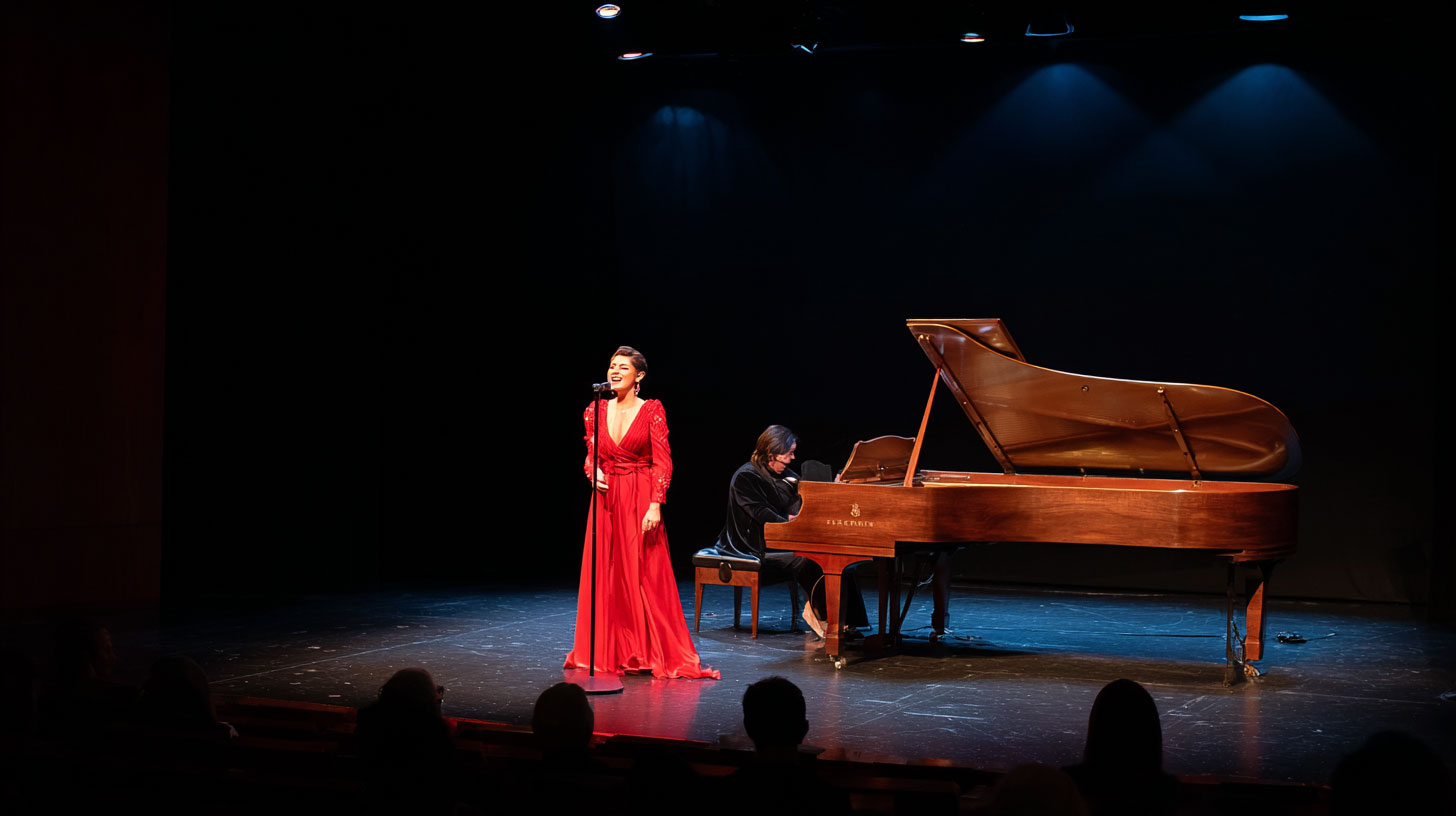
Applying a little bit of interpretation to this, what I think we have is a singer and piano. Since this is classical music they perform at the same time. (Mozart didn't do overdubs.) There is a vocal mic for the singer and three mics in a Decca Tree. There is also a mic under the bass end of the piano. Clearly the mics are at different distances from the sound sources, and therefore there will be relative time delays between the mics.
Let's start with the Decca Tree...
The Decca Tree, a microphone configuration invented by the Decca recording company, consists of two microphones spaced two meters apart, with a third microphone exactly in between but normally 1.5 meters forward. Nominally the microphones should be omnidirectional, but I was told personally by Decca engineer Gordon Parry that the mics they used were in fact directional in the higher frequencies.
The purpose behind the Decca Tree in the 'classical days' of classical music recording (late 1950s to early 1970s) was to produce a standard house sound, so that any Decca recording would sound pretty much like any other Decca recording, and different to any other classical record company. CBS was another company with a house sound. EMI's recordings were not so similar to each other. Another feature of the Decca Tree is that it can sound fantastic. That is still so.
These days, the reason you would choose a Decca Tree is because you want an overall stereo configuration, but you find the sound of a coincident pair too 'closed in', for want of a better expression. Conventionally spaced omnidirectional microphones sound more open, but the stereo image is imprecise. The Decca Tree can be thought of as the Goldilocks configuration - just right.
Having two spaced omnis, as I said, produces an open sound. But the center image is weak. So adding a third mic in the center, probably at a lower level in the mix, corrects this. Moving it further forward advances the center image in time, providing a further strengthening effect.
Now what you might consider is that the Decca Tree is straightforward to use for an orchestra in a large auditorium. You just need to find the right distance from the front of the orchestra and the right height.
But in a small room on a smaller ensemble, the center mic is proportionately closer to the instruments. And the outrigger mics are proportionately further apart. So for this reason, you might choose not to be so religious about the dimensions of the tree. In fact, you might decide that it is easier and better to use a coincident pair, and compensate for any lack of openness with two distant, spaced ambience microphones.
But back on the tree. The center microphone of the standard Decca Tree is 1.5 meters in front of the outriggers, which would correspond to a time advance of around 4.5 milliseconds from the baseline of the outriggers. You might consider compensating for this. The Decca engineers in the old days didn't do this because the technology hadn't been invented!
That deals with the overall stereo pickup, so let's look at the close microphones...
The question here is why do you want them? Classical music is meant to be heard acoustically, so why not put a stereo configuration in the best listening position (best for microphones, that is) and record that?
There is a problem with this for large orchestras. Microphones don't have the selectivity of the human ear, so they always have to be placed closer to the sound source than a natural human listening distance. But then the mics are closer to the front of the orchestra than the back. So the back of the orchestra needs mics too. Taken to its logical conclusion, you end up with a main stereo configuration and sectional mics for the whole orchestra. Usually the closer microphones are brought up in level just enough to add a little extra clarity, and compensate for any imbalance in level.
But when you use a main stereo configuration with a small ensemble, this problem with perspective doesn't arise. All you have to do is find the best position.
Even for classical music however, you might prefer the sound of close mics, on both voice and piano. So if you like it, you can do it!
With only the close mics, the sound would be very dry, so you would definitely need a pair of spaced ambience mics out there in the room. But you could balance the sound on the close mics and the ambience mics alone. Having a main stereo configuration also is a bit like having steak and fries, and pasta as well.
The problem here as I see it is not a question of time delays, it's a problem of having too many microphones. You could try and calculate the correct delays, but when microphones are spaced out it gets so complex that even Pythagoras couldn't do it in a way that would be fully accurate for every mic.
So here are three possible ways to consider recording classical voice and piano...
- Use a stereo configuration of your choice in exactly the right position to capture the best sound, and the best balance of direct sound and reverberation from the room
- As above but place the main stereo configuration a little closer for more clarity, and add two spaced ambience mics at a distance
- Junk the main stereo configuration and use close mics (two for the piano, and probably not under it) and two ambience mics.
Time correction is not necessary for any of these methods.
Let us know how you get on.

David Mellor
David Mellor is CEO and Course Director of Audio Masterclass. David has designed courses in audio education and training since 1986 and is the publisher and principal writer of Adventures In Audio.


