
Noise gate side chain filters
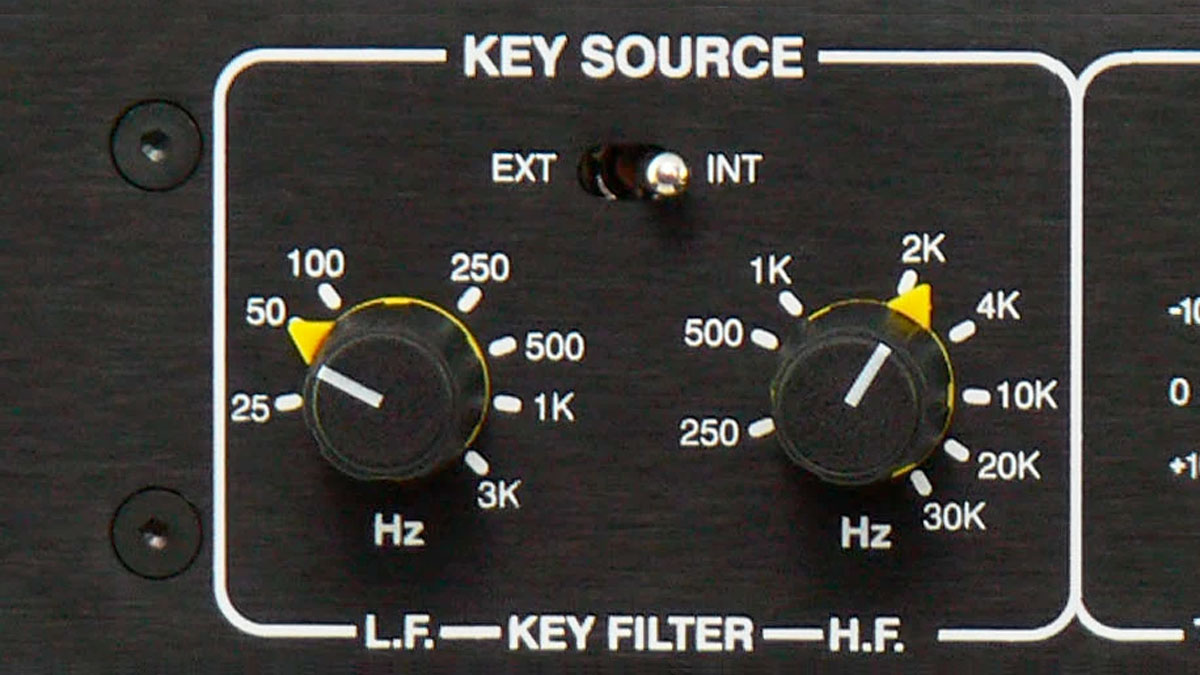
Basic gating is easy enough when the sound source is well differentiated between
signal and noise.
But there are times when the noise is so high in level that setting the threshold
to a point that fits neatly between the signal and the noise is impossible.
A good example would be the drum kit, particularly the snare drum and hihat.
The snare and hihat are so close together that the snare mic will pick up as
much level from the hihat as it does from its own instrument.
It will be impossible to set the threshold for correct gating.
The solution to this problem is found in the filter controls. Just like a compressor,
a noise gate has a 'side chain' signal that is used to control the behavior of
the processed signal.
In a gate, this is commonly called the trigger, or key signal. In normal use
with the filters set to their end stop positions - so that they have no effect
- the key signal is identical to the input signal. Indeed it is just tapped
off from it.
To stop the hihat from opening the gate on the snare mic, simply filter out
the high frequencies from the key. The snare is sufficiently rich in low frequencies
that it will still open the gate, but the lesser LF content of the hihat is
not enough to do the same.
If there was a mic on the hihat suffering from the same problem, then the low
and mid frequencies could be filtered out of the key, and the rich high frequency
energy of the hihat would still open the gate.
One important point to note is that the filters have no effect on the frequency
balance of the output signal. They only affect the key, which once it has done
its job goes nowhere.
There is a function, here called 'key listen' that switches the key signal
to the output. This can be used for setting up the gate, then switched back
to 'gate' for normal operation.

David Mellor
David Mellor is CEO and Course Director of Audio Masterclass. David has designed courses in audio education and training since 1986 and is the publisher and principal writer of Adventures In Audio.


