
MIDI OUT - what use is that?
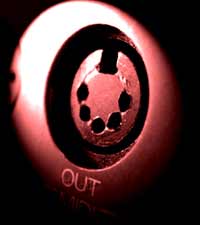
Your MIDI keyboard has a MIDI OUT socket, and you use it all the time. The data generated by playing the keys flows through the MIDI OUT to your sequencer or sound modules.
Your sequencer, or the interface you use with it, has a MIDI OUT too. This sends data to your sound modules.
But if you look round the back of your MIDI sound modules, samplers and effects units, you will find that they all have MIDI OUT sockets too. And you probably never use them.
The fact that MIDI has been around so long is testament to how clever it is. And amazingly it is still on version 1.0!
MIDI has three types of output sockets - OUT, THRU and MERGE. If you would like to call yourself a music technology expert, you would need to understand all of these.
MIDI THRU is widely used. The MIDI THRU socket outputs an exact copy of the data present at the MIDI IN socket, with no delay (in correctly designed equipment). It adds nothing and takes nothing away. The MIDI THRU socket is used to connect a 'daisy chain' of equipment where each item responds to data on its own MIDI channel.
The MIDI OUT connector is completely different. It outputs data generated by the unit. For a keyboard or sequencer this is obvious. But for a keyboardless sound module, where is the data to be generated?
The answer is that you might want to perform a System Exclusive dump to store the internal settings, probably into a sequencer. There might also be the rare occasion where a module might output trigger or clock data, but this would be unusual. MIDI effects units too can do this, so you can store all your favorite settings as part of a sequence, to be restored automatically when the sequence plays.
The reason why MIDI OUT isn't used so much in this way is that it involves re-plugging your system. MIDI only transfers data in one direction - it can't send data from a sound module back to the sequencer unless you re-plug.
MIDI MERGE is used where you want to combine one MIDI data stream with another. An example would be where you are synchronizing two pieces of equipment using MIDI Clock or MIDI Timecode, and you need to incorporate this with note data from a keyboard.
In summary...
- MIDI IN accepts data into the unit
- MIDI OUT outputs data generated by the unit
- MIDI THRU outputs an exact copy of the data present on the MIDI IN socket, with no delay
- MIDI MERGE combines two MIDI data streams

David Mellor
David Mellor is CEO and Course Director of Audio Masterclass. David has designed courses in audio education and training since 1986 and is the publisher and principal writer of Adventures In Audio.


