
How to blow your speakers in one easy lesson!
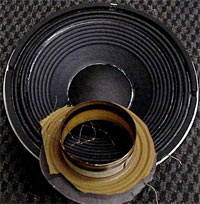
Have you ever blown a loudspeaker? Then you probably don't want to do it again. Here's how not to shred your cones...

There are two ways in which a moving coil drive unit may be damaged. One is to drive it at too high a level for too long. The coil will get hotter and hotter and eventually will melt at one point, breaking the circuit ('thermal damage').
The drive unit will entirely cease to function. The other is to 'shock' the drive unit with a loud impulse. This can happen if a microphone is dropped, or placed too close to a theatrical pyrotechnic effect. The impulse won't contain enough energy to melt the coil, but it may break apart the turns of the coil, or shift it from its central position with respect to the magnet ('mechanical damage’). The drive unit will still function, but the coil will scrape against the magnet producing a very harsh distorted sound.
Many drive units can be repaired, but of course damage is best avoided in the first place. The trick is to listen to the loudspeaker. It will tell you when it is under stress if you listen carefully enough.
One common question regarding damage to loudspeakers is this: what should the power of the amplifier be in relation to the rated power of the loudspeaker?
In fact, although the power of an amplifier can be measured very accurately, the capacity of a loudspeaker to soak up this power is only an intelligent guess, at best. During the design process, the manufacturer will test drive units to destruction and arrive at a balance between a high rating (in watts) that will impress potential buyers, and a low number of complaints from people who have pushed their purchases too hard.
The rating on the cabinet is therefore only a guide.
To get the best performance from a loudspeaker, the amplifier should be rated higher in terms of watts. It wouldn't be unreasonable to connect a 200 W amplifier to a 100 W speaker, and it won't blow the drive units unless you push the level too high.
It is up to the sound engineer to control the level. Suppose, on the other hand, that a 100 W amplifier was connected to a 200 W loudspeaker (two-way, with woofer and tweeter). The sound engineer might push the level so high that the amplifier started to clip. Clipping produces high levels of high frequency distortion.
In a 200 W loudspeaker, the tweeter could be rated at as little as 20-30 W, as under normal circumstances that is all it would be expected to handle.
But under clipping conditions the level supplied to the tweeter could be massively higher, and it will blow.

David Mellor
David Mellor is CEO and Course Director of Audio Masterclass. David has designed courses in audio education and training since 1986 and is the publisher and principal writer of Adventures In Audio.


