
Flute, clarinet and other woodwind - how much key clicking is too much?
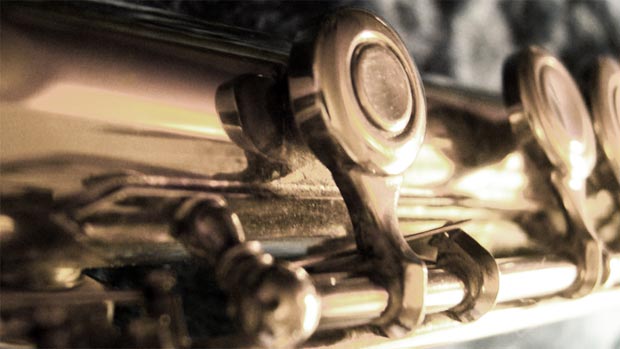
We received a recording of solo flute at Audio Masterclass Towers recently. The sender was enquiring whether the amount of key click noise was too much.
Originally these instruments had no keys, and therefore no key click noise. That however was more than a hundred years before the invention of recording so there was no-one around to appreciate the benefit.
But wily inventors added first one key, then another, all in the interests of player convenience and extending the range of the instrument. In modern instruments, all or nearly all notes are produced using keys, rather than stopping the holes directly with the fingers.
Inevitably this causes a mechanical noise that is easily picked up by sensitive microphones. So what can you do?
The first thing you can do as a recording engineer is consider where the normal listening position for a woodwind instrument would be. Would it be ten meters away or more if the instrument were in an orchestra? Would it be two or three meters if you were sitting in the front row in a small recital? Would it be a couple of centimeters from the instrument if you wanted to get the same experience as a close mic?
For some reason that acoustic science finds it difficult to explain, key click noise seems to disappear with distance. You would almost never become aware of it in an orchestral concert.
But the close mic sound is very attractive. If you must have that sound, what can you do about the key clicks?
The first thing to do is have the instrument serviced. Players tend not to notice the gradual degradation in performance of an instrument between services. They hear the key clicks every time they practice and cease to notice them.
This might not be practical and you have to deal with the instrument as it is.
You could try asking the player not to click so much. This will probably produce no noticeable benefit and the performance will suffer because the player is now distracted.
One thing you can do successfully is move the microphone towards the source of musical sound and away from the mechanism causing the clicks.
Woodwind instruments produce sound from three places - the mouthpiece or reed, the opening at the end (the bell in the clarinet and oboe), and from any holes in the instrument that are not covered. This last source changes from note to note, and you will hear this clearly if you listen from close range.
So if you move the microphone closer to the mouthpiece or reed, or to the opening at the end, you will increase the amount of musical sound slightly and decrease the level of the clicks. You can also experiment moving the microphone around the instrument to the side that has fewer mechanical parts.
Two points...
1. Don't expect miracles. Expect a small improvement at best.
2. Moving the mic will change the sound quality, perhaps not for the better.
There is however another solution that trumps all the rest, and that is to accept these noises as part of the texture of the instrument.
All acoustic instruments have texture and this is something that gives an instrument its character.
This can come as a surprise if you have learnt recording on synthesized and sampled instruments. But texture can be a large part of the 'soul' of a recording and something to be welcomed, in reasonable quantities.
We would like to hear about your experiences with the 'texture' of acoustic instruments.
What non-musical sounds do you like? And what drives you crazy?
If you can e-mail us an example, we would love to hear it and perhaps publish it on the site - address down in the footer...

David Mellor
David Mellor is CEO and Course Director of Audio Masterclass. David has designed courses in audio education and training since 1986 and is the publisher and principal writer of Adventures In Audio.


