
Do you have problems recording bass guitar?
Here's an interesting question I received the other day...
"Hi David, however I try, I can't seem to make my bass lines sound clean and distinct on my home studio setup. Admittedly, I'm only running the Steinberg Studiocase 2 with lots of VSTs, but even when I record my clangy Rickenbacker with an SM57 (and no EQ adjustments) the bass is too bassy and boomy. Using a bit of EQ seems to have an 'all or nothing'. I generally use the Rick (compressed via a Behringer 2600 inserted into the desk channel) or my Minimoog VST for bass lines but they don't sit well. Am I doing something garishly wrong?" - Frank de Pellette
Actually, this is several questions coming all at the same time so I'll have to break it down a little.
Firstly there is no reason why Frank's recording system should be causing the problem. These days it is no problem to record with a flat frequency response, low distortion and low noise. Cubase SE3, which is included in the Studiocase 2, is perfectly capable of that. Frank doesn't mention which soundcard or interface he uses, but as long as it is one that is normally sold into the pro audio market, and is compatible with Cubase, it shouldn't be a problem.
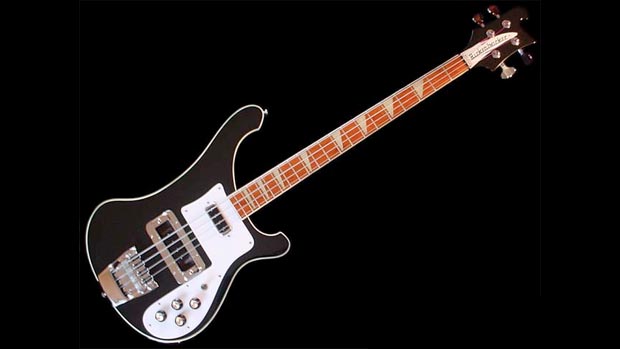
Frank describes his Rickenbacker bass as clangy. Yes it will be - I used to have a Rickenbacker 4001 myself so I know all about that.
But a lot of the clanginess of this bass is in the playing. Often it is better to record a tighter sound than you would use live. You can do this by removing the bridge and pickup covers (and sell them on eBay - I've done that) and lightly damping the strings with the side of the hand very close to the bridge. You can vary the position and pressure to go from zero damping to very damped, with a little practice.
The Shure SM57 microphone is not a problem. But the amp and cab may be. Some models that are quite popular are, in my opinion, not particularly good for recording.
I recently recorded bass through a Marshall amp and 8 x 10 cab. Even well cranked up, the sound on the recording was thin and weak. Then I found an ancient Marshall guitar amp lying around. The sound was incredibly richer through the same cab.
I sometimes record my Fender Precision bass through my Fender Twin combo. Yes I know it's supposed to be a guitar amp, and I could blow the speakers with bass. But I like the sound it makes for recording, and I'll take the risk. (I've only blown one speaker so far!)
One thing that is certainly to be avoided is a transistor amplifier. However cleverly transistor amps are marketed, they don't sound the same as tube amps. They just don't. And when there are so many tube amps available, it seems perverse to buy something that isn't as good.
It is possible that the acoustics of the room are a factor. However, if the mic is placed right up against the grille of the cabinet, the direct sound will be so much louder than any reflections that acoustics will hardly make any difference.
By the way, you can often get a fuller sound by putting the mic at the edge of the loudspeaker cone, rather than the center. Try it and see.
One thing is for sure, before I move on... you have to get the very best sound you can on the recording BEFORE you start experimenting with EQ or compression. EQ can sometimes fix problems, but it's better not to have problems in the first place. Compression can never fix a problem. If the sound is basically good to start with, then any excessive low frequency energy can be rolled off with a little EQ. The sound needs to be really very damn good indeed before you start to consider compression.
Moving on to the Moog software instrument...
This is a recreation of the original Minimoog analog synthesizer. Can I tell you something about the original Minimoog - IT MAKES GREAT BASSLINES!
Getting a firm, solid, rich bassline with a Minimoog just comes naturally. And you can plug it straight into the console without using an amp and cab.
Anyone who was using a genuine Minimoog and wasn't getting great basslines would have to be getting something very wrong indeed.
However, we are not talking about a Minimoog, we are talking about a software emulation. Some software emulations are good, some not so good.
I am not familiar with this particular software instrument, but it wouldn't surprise me at all if there was some distance between the way it sounds and the way a real Minimoog sounds.
My advice would be to go back to the bass guitar. Start with the playing technique, make sure the amp and cab sound good for recording (not just to the naked ear), and optimize the mic placement. This is exactly what pro musicians and engineers do, and it's good advice for anyone.
Get the very best sound you can without EQ or compression, and then you have a firm foundation on which to build.

David Mellor
David Mellor is CEO and Course Director of Audio Masterclass. David has designed courses in audio education and training since 1986 and is the publisher and principal writer of Adventures In Audio.


