
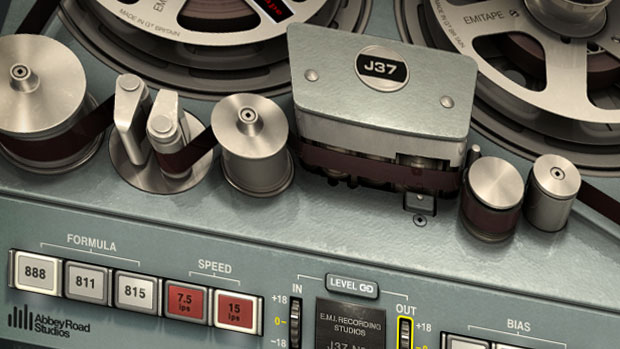
Demonstrating the Waves J37 analog tape emulation plug-in and comparison with a real tape recorder
It is strongly recommended that you should listen to this video on loudspeakers or headphones of studio monitoring quality.
Transcript of the video sound track...
I'm going to take a look at the Waves J37 tape emulation plug-in. I'm going to try it on a variety of signal sources, and also compare it with a real tape recorder.
First I'm going to experiment with a simple sine wave and play around with the controls. You will be able to see and hear what the controls can do to the sine wave. I'll start with the bypass control, and then get a bit more adventurous. One thing you might notice is that tape produces harmonics that are odd, whole-number multiples of the input frequency. Even-order harmonics, as you would find in a single-ended Class A amplifier are not present. This, in a way, gives tape its characteristic sound.
[Sine-wave demonstration]
Now I'll play around with the wow-and-flutter controls. Obviously in the heyday of the J37 the object was to have as little wow and as little flutter as possible. But now we can use it as an effect. Let's see what it can do to a sine wave. Sometimes the effects can be extreme.
[Sine-wave demonstration of wow and flutter]
There are some characteristics of analog tape recorders that I don't feel that I am hearing here. One is scrape flutter. Scrape flutter is caused literally by the tape scraping against the heads and guides of the machine. Scrape flutter causes harmonics which are not related in any simple way to the fundamental frequencies, and it makes a mass of them, a whole cloud of harmonics, and I don't feel that I am hearing them, and I certainly can't see them on the spectrogram. The second feature of analog tape recorders is modulation noise. This is noise that comes and goes with the level of the signal. I can demonstrate that neither of these are emulated in the J37 plug-in by using a low-frequency sine wave input signal. With a real tape recorder, you would hear this cloud of harmonics around the sine wave, but here it comes out very clean. And also, whether or not noise is introduced with the noise level control, it doesn't alter with the level of the signal. Take a listen to this...
[Investigation of scrape flutter and modulation noise]
Sine wave tests can be instructive because they show you what to listen out for. But here's a real-life signal. Here's a vocal recording, which we made using a Neumann U87 microphone through an Avalon M5 preamplifier. First we'll hear the clean digital recording.
Female vocal
[Original female vocal recording]
Now let's try it through the J37 plug-in. The settings have been chosen to produce quite a strong effect. So in the louder sections you should clearly hear the additional warmth that's produced. A little speed variation has been introduced as well.
[Female vocal processed through J37]
It's certainly a richer sound, but exactly what are we hearing? I've made a little test where I've taken the J37 version, and I've mixed that with an inverted version of the original digital signal. It doesn't cancel completely, but it allows us to hear more of what the J37 is doing. This isn't a sound that you would use in a real-life project perhaps, but it lets us hear a little bit more about how the plug-in is working.
[Female vocal, mix of processed version and inverted original]
Bass guitar
Let's move on to a recording of bass guitar. What I'll do in this example is switch the plug-in in and out repeatedly. You'll hear it change because there's a little click. Perhaps Waves has modeled a DC offset in the original J37. One interesting thing that you might notice is that the processed signal subjectively sounds louder and stronger, but in fact the peak level in this test is a little bit lower. That tells us something about what tape can do for a signal.
[Bass guitar comparison]
Drums
One of the classic applications of analog tape is for drums. If we think about the original era of the J37, during the 1960s, then typically the drums might have been recorded by just one mic. So here we have exactly that kind of recording. The setup is a single Neumann U47 directly in front of the kit. We'll hear it digitally recorded, then processed through the Waves J37 plug-in.
[Single-mic drums clean]
[Single-mic drums through J37]
As a more modern alternative, we have the conventional method of miking each drum separately, and the hihat, and two overheads, which results in an 8-mic setup for a five drum kit. We've recorded it digitally, and also processed it through the J37 plug-in. This time however, what we've done is process each track independently. So each track, each microphone, has its own separate instance of the J37 plug-in.
[8-mic drum recording]
[Multiple instances of the J37 plug-in]
Background vocals
Using multiple instances of the J37 plug-in is actually something that Waves recommends. Here we have a recording of background vocals where there are six tracks, and each is processed independently through the J37 plug-in. First we'll hear the original recording, then we'll hear the processed version. You might hear a little noise in the original version, but we'll have to accept that as part of the overall texture.
[Unprocessed background vocals]
[Background vocals processed through the J37 plug-in]
Comparison with a real tape recorder
What I'd like to do now is compare the Waves J37 plug-in with a real analog tape recorder, in this case the Revox PR99. I've recorded a sine wave and, as you will see and hear, on playback from tape, the result is quite messy. I have to say that there is a richness of texture here that the Waves J37 plug-in doesn't quite manage to imitate.
[Sine wave recorded on a real tape recorder]
Here I have a stereo recording of drums, which we will hear first in its original digital form, then through the Revox PR99, then through the Waves J37, and then through a different tape emulation plug-in. You will certainly hear differences in texture, and there are differences in the warmth and the richness of the sound. One interesting feature is that all of these recordings are normalized to the same peak level, but you will hear that some, subjectively, sound significantly louder than others.
So there we have it - a quick demonstration of the Waves J37 tape emulation plug-in. Thank you for listening.
Comments on this video
You can comment on this video at YouTube
You can comment on this video at YouTube


@petespencer-smith5059: Why didn't you gain match the comparisons using the level link button? It's impossible to differentiate between the increase in volume and any genuine tape emulation.
@AudioMasterclass replies to @petespencer-smith5059: My memory doesn't seem to extend to the more than eight years ago when I made this video. You are correct of course that level affects judgment so in similar videos I often do correct the level so that whatever I'm comparing is the same level as the original. However this does slow down the video making process and there's an alternative argument to say that an engineer should be able to make judgments even when the levels are different. That's a good skill to have because in normal studio operations you're changing the level all the time and it isn't practical to make a correction each time you, for example, EQ. These are my thoughts and I appreciate your comment. DM
@kyma1999x: well....revox wins with no doubts! but we knew it..
really surprised of how good sounds old avid/digidesign plug ins, seems more natural and deep than j37 which remains however a good compromise.
It would be nice to hear it compared to two oldies pro tools classics, DUY tape saturator and McDSP AC.
@ronbynum7304: Thanks for this fairly comprehensive demonstration of an often misunderstood reason some of us love magnetic tape. For many engineers this particular plugin makes recording in the digital realm barely acceptable. Tape had its limitations, and perpetual bothers, but the sound made the "bothers" more than tolerable - especially after hearing digital trash.
@vikingsofvintageaudio7470: You glorious genius! 😍
@guilhermeviegas6139: how to invert and audio and hear this?
@TheLboogie330: I had this j37 since it came out spend about 300 for it and never thought to demo it like this great stuff
@AiMR: I'm waiting for the Waves wax cylinder VST.
@dermatze2309: Great demo. A little extreme in places but good to get the point across. I'll try this out to add some life to slightly sterile sounding sampled keyboard sounds. Might be just right for that.
@AudioMasterclass replies to @dermatze2309: Thank you for your comment. Regarding being extreme at points, my feeling is that if you don't step over the edge then you don't know where the edge is. I learned a long time ago from successful engineers that they would push equipment as far as it would go to find out what it was capable of. They could then use it to the full.
@Randuski: I was hoping this would be a more subtle use of the J37. Every time he used it he was driving the crap out of the tape, which isn’t really what i wanna hear
@AudioMasterclass replies to @Randuski: My feeling on this is that if you don't step over the edge then you don't know where the edge is. I learned a long time ago from successful engineers that they would push equipment as far as it would go to find out what it was capable of. They could then use it to the full. DM
@qbertykey6223: You sound like young Terrence Stamp. But this demo sucked...
@BeckMutations2: Regardless of what people think about the plugin, this demo and analysis is top-notch. Seriously. If everything were this well-researched and tested, life would be so much easier. Even with the limitations and issues, just bought this plugin on sale to try for myself.
@petespencer-smith5059 replies to @BeckMutations2: I disagree with this being a quality demo. He didn't gain match so all we are hearing is a difference in volume.
@triple_x_r_tard replies to @BeckMutations2: @petespencer-smith5059 you are such a dunce. i'll pray for you.
@musicdreamerish: This may be the best plug ever made, and I mean of all companies. I love all the Abbey Road Waves stuff, but one problem, this stuff is a CPU KILLER on my poor little laptop. I love that Abbey Road Plate reverb, man oh man it sounds sweet, but, uh, I can't use it unless I freeze a bunch of tracls and the same with this take and AdT doubler plug, it's another astounding Waves plaug. I guess they have to push the cPU to get us closer and closer to the real stuff, so I know it is times for a computer upgrade, I just dread going through that nightmare again.
@Neltarian: This is the really useful review! Thanks!
@zimouspero: The j37 plugin is bettee then The analógic gear if you know how to use it. People want to use everything because somebody told them. Music is feeling and thats The point. Gear will be gear forever But capture de pure emotion in a song or instrument depends more then a simple gear.
@LivesoundUK: That effect is neither wow or flutter!
@NovianLeVanMusic: I don't think this is a very good comparison video. The before and after audio is not level matched, so it's perceived as sounding better because of the J37 boosting the volume.
@RandyJohnsonRikthove: This was a great review in terms of format. Really gives you the knowledge you need to leverage this plug-in's capabilities intelligently rather than just fumbling with the controls and hoping to find something that works.
@monohive: Waves tape emulation sounds terrible to my ears. I find the ones that come with Nebula by Acoustica-Audio much more useable.
@SynthOSphere: BEST J37 demo out there. THANKS!
(and THANK YOU for not talking DURING the listening parts, unlike other J37 demos...)
@AudioMasterclass replies to @SynthOSphere: Thank you for your comment. We prefer not to have commentary during audio demonstrations and also, very importantly, the signal from the microphone is muted, otherwise any background noise would affect the demonstration. Some might see this as a small detail but we think it is important.
@ricksalt6860: pretty good video
@jen3800: wow. that sounds so harsh on the female vox! all upper mids, distorted and hyped. completely unlike a real tape machine. of course, i have only used 2 inch and 1/2 inch machines, and a 1 inch 8 track on occasion, so what the hell would i know? if they say it is better it must be, right? everyone else does it, right? must be good, right?
dream on. you kids will never learn. suckers til the very end. got the latest apple me-phone yet?
@freasy123: Very good comparison. I would have liked to hear even more different plug-ins on the same material, e.g. those from Toneboosters (Ferox and Reelbus), which I find very useful quite often.
@MacXpert74: Although the plug-ins have their use, It's clear the real Revox tapemachine killed them in terms of dynamics and clarity.
@alf3k1: Compared to real tape, the J37 flattens out the attack transients a lot, to bad :(
@alf3k1: That snaredrum in the drum solo at 16:10 RULES, I totally love it tuning / sound-wise. Which one is that?
@daquetreed5522: Im listening to the drum example through a pair of Sony MDR-7506 and it sounds pretty close to me. Obviously the plugin isnt going to sound 100% like the original but its definitely within the 75% to 80% range. To put it into perspective there's a Studer j37 on ebay right now for $21,000 and a PR99 for $5,000. I'd say the $300 plug-in with 80% of the original sound is a pretty good deal.
@daquetreed5522 replies to @daquetreed5522: Great video BTW!!!!!
@AudioMasterclass replies to @daquetreed5522: Thank you. DM
@yavamaystudio8380: Its not the same and never will be the same like real reel to reel .with plug in sounds tinny.
@credenza1: How high-spec would a tape machine need to be to achieve these effects? For example, there are (were) many cheaper reel-to-reel machines around. Would similar effects be achievable with them?
@AudioMasterclass replies to @credenza1: The minimum standard should be a secondhand Revox A77 or B77 in very good working order. Anything less than this is going to be difficult to work with or will give results of less than professional standard.
@mikebrun.mp3: thank you so much for creating this review! thorough and helpful.
@obaysh2789: awesome review
@AllanEvansOfficial: that revox has major punch and beef on that drum compared to the plugs
@catzilla6279: That sine wave sounds horrible with the plug on heh. Prob good for a thick bass though.
@PatFleck replies to @catzilla6279: Max Cherry i
@ShankYouKindly: why does this guy's voice sound like he's a British dude in a south park episode?
@GnarlyTones replies to @ShankYouKindly: Haha, made my day!
@MekLowin replies to @ShankYouKindly: hahahaa
@RedAvery1 replies to @ShankYouKindly: True
@AgentsofRush replies to @ShankYouKindly: Sounds like a guy here called Vic Reeves :D
@dinmentor replies to @ShankYouKindly: man this made me laugh so hard...
@GhostXb: Love those tape drum demo's. Been trying to get that tape sound for a while. Glad this was on sale this weekend :)
@Neil-Aspinall: Interesting but in future keep the examples much shorter, BORING! Good games' a Quick game
@TorpidScorpionMusic: this is a really great video; both in terms of exploring the details of tape emulation with a range of instruments, and to teach how to approach evaluation of plugins in general. the only thing I would note is that you should have more consistently played with makeup gain to keep the levels the same when A/B ing the clean and processed signals. keep it up!
@eatingcatshit replies to @TorpidScorpionMusic: But you see that's what a real tape recorder would do. You can top off the peak of both recordings, and if you push the gain into a real tape machine somethings will sound louder. The reason for this is that sound usually starts with a physical body (person, voice box, drum kit, saxophone etc) making the sound. Certain parts of that instrument are more quiet than others. And some of those parts that happen to be more quiet may have higher, more complex frequency harmonics. So when you squash the single, it pulls the more quiet sounds up higher with the loudest ones. If the more quiet ones are rougher in timbre (like drums, cymbals, fuzz guitars) they will sound louder.
Some sounds when amplified hurt your ears more than others. So if a thumpy drum has something about it that's a bit sharp, yet more quiet, it then has that rough, grating sound pulled up to the top as if suspended in jello, it gets squished. You then think it's louder because the frequency properties have shifted even if all sounds volumes are normalized against each other. That's part of the allure of tape machines. Pushing them a little to reshape the dynamics, and getting a "warm" response, as opposed to a digital break up and clipping. But that's what these new plugins are about, to not let that clipping happen in a pure digital sense, but to soften up the signal, much as tape does. The only thing he could have done was to make the gain of the compressed signals more quiet. Again the frequency response of the instruments is warped whether it's real tape, or a plugin emulation. That's part of the point and one of the pros. There are others.
@maximusquavius2453: My take on this is: Live performances have the dynamic range that audio recorded media can never achieve. Barring that, reintroducing wow and flutter purposely into a mix might be commendable if you want to emulate a 70's era technology, but that in itself creates another veil of auditory simulation that further distances the recording from the live performance dynamics. I'd rather be in front of the band and hearing it than sitting in a room and experience the equivalence of auditory braille.
@eafortson replies to @maximusquavius2453: +Maximus Quavers Personal preference I guess. I grew up on recordings (vinyl and CD's). I learned over time that don't enjoy live shows precisely because the dynamics are not controlled enough. Terrible acoustic environments, terrible equipment and sound engineers, bad mixing on the console, and just plain terrible performances have lead me to prefer listening to music that has been processed and treated by a qualified mixing and mastering engineer. For me its like, I'd rather have a gourmet meal in a nice restaurant with brilliant ambiance cooked just for me by a master chef and served by an attentive waiter (recording) over an assembly line of unskilled laborers at a buffet (live show). The Chef will have a predictable level of quality and a signature experience. The buffet will vary wildly and be unpredictable depending on who is working that night.
There are exceptions of course. But generally aside from the excitement of the experience itself (like when I saw Radiohead in Amsterdam) Id rather listen to quality record through my predictably trustworthy hifi any day over the gamble of a live show. Way to many variables.
@nocaster9: drummer needs to stop doin cocaine
@8KILLSTEP replies to @nocaster9: Juan Sánchez imdyyyn
@newton21989: Sounds much dirtier with the plugin. Why, after creating a nice, clean digital recording would anyone want to reintroduce this?
@iamnotbabyblue replies to @newton21989: that’s the fkn point dumbass
@yrrahyrrah: Great demonstration. Loved the sine wave experiment with the frequency response graph to the right. Also, great comparison to the real tape recorder! Awesome.
@WarhoundOfficial: As of this being a audio masterclass, you really should make sure the audio lvl's are the same else people will just favor the "louder" recordings XD
@AudioMasterclass replies to @WarhoundOfficial: Thank you for your comment. Yes indeed even for experienced listeners 'louder' often seems to sound 'better'. How loud something sounds is however very much a subjective issue. Whether or not it may be technically possible either in the present or the future to adequately equalize all of the levels of all of the audio material on the Internet, an awareness of the issue is very useful for any audio practitioner to have.
@AveMcree replies to @WarhoundOfficial: +Blaize Music sounds like you didnt watch the whole video which seems to be the real problem
@rexydallas8D replies to @WarhoundOfficial: I ain't no professional, but in music louder levels almost always equals worse to me because it tends to cut out the dynamics, and hurts my ears. I almost always pick the quieter masters of music, because I know it will be less clipped.
@MikeStrobino: Sounds too much dirty , the Slate Digital VTM is in another planet !
@petervad: Thanks; makes for very instructive listening.
@FVDaudio: Excelente.
@phlopalopagus: You would think with the outrages price of these plugins they would all have an option to keep the volume consistent so one can hear the difference instead of it just being way louder so as to not hear the effect being used.
@rickyjlewis9949: J37 is sounding really poor (((
@hrflikk: vocals sounded shity whit the plugin.
@ivayloivanov3744 replies to @hrflikk: also the drums at 12:00 sound better with plug-in bypassed
@Rocksite1: Hmmm. I'm just an amateur at this point, but here's my $0.02. I'm not hearing many things others say they are. The kick on the Revox and J37 sound the same to me; and as there are no toms, that's all I had to judge the bass by. At first, I thought the Revox and J37 sounded similar; but on listening more, I do notice that the snare is a LOT toppier on the J37, as are the HH and crashes. Thus, the Revox is a lot more transparent/natural, while providing a lot of compression/subtle distortion/mojo, or whatever it is.
@Rocksite1 replies to @Rocksite1: Rocksite1 BTW: This is an excellent review: demos of different crucial instruments, A/B-ing with a vintage hardware unit, studying the effect on a sine wave, comparison with a competing unit, and most importantly: quick switches between on and off, or different plugins, on material that doesn't change parts of songs radically in the middle, and you let it play long enough to give us a real listen, instead of switching between different fx so quickly and annoyingly we can't hear what's going on. You "killed" this review, as it were; but then I guess you already know that.
@AudioMasterclass replies to @Rocksite1: Rocksite1 Thank you - I do my best. David Mellor
@dnpfrrnp4287: too much differances in dynamic range !!
analog reel tape recorder processed sounds are like just normal and real like sound
but
not analog reel tape recorder processed sounds are unnormal, narrow dynamic range, too much all bandwide detail data losses ... etc...
@luckystrke: Great video!
@Madrrrrrrrrrrr: The low on the revox is superb. Kick and snare both add bottom without loosing balance of the mix. Also it kind of glued everything together. The J37 separated the sounds some what. Kind of anti glue to my ears.
@TheAerovons: Revox was the best
@TheAerovons: One thing younger people are missing is.....no decent engineer would have allowed a vocal to be distorted like the vocals in this tutorial (and I don't mean the extreme example, I'm talking about even the first example). That was NOT a desired effect of recording to tape. We used to hear crap like that and say "We need to do it again, it's too hot." Now it's a feature lol
@ANTHONYFERNANDO replies to @TheAerovons: Overdriven guitars started out as an unwanted by product of running an amplifier's tubes too hot. Then it became a desired effect just the same. Are you gonna speak ill of overdriven guitar tones as well? People grew to like the sounds of hot, overdriven signals as they're pleasing in certain uses. Get over it
@TheAerovons replies to @TheAerovons: AnthonyPudduMusic Hey Anthony....I've been in studios since before you were born and still am...I don't need lessons.
No one in analog days of tape made tape machines sound like crap on purpose Go listen to the top ten pop, country, and rock records from this week alone. Tell me which ones have total mixes that are distorted. Get over yourself.
@ANTHONYFERNANDO replies to @TheAerovons: TheAerovons You literally just ignored everything I said and restated your point. Sigh...
@TheAerovons replies to @TheAerovons: AnthonyPudduMusic No you missed the point entirely. Overdriven guitar sounds were quickly picked up by all guitarists in pop/rock music ( I am one).....they didn't take DECADES to catch on. Tape machines have been around for DECADES and DISTORTED MIXES have never CAUGHT ON or been something desirable except in the rarest of cases were a specific sound like a voice or other instrument is being affected. This plug in (which I own) and the others like it (Steven Slate, Waves, etc) can be used for THAT kind of thing, but no one uses it for 2 mixes to totally screw them up. If it were going to be a case of it "catching on" it would have done so. It is the equivalent of saying out of tune guitars may "catch on" lol
@ANTHONYFERNANDO replies to @TheAerovons: TheAerovons Exactly the same situation with amplifiers. Amplifiers overdriving is not a desired effect except with the specific rare cases such as bass or guitar. Almost every other application of audio amplifiers people prefer clean. Just because it took longer for a hot slightly overdriven vocal signal to catch on than it did with amplifiers doesn't make it not okay?
You don't like it and that's fine. But everything about my comparison is exactly the same except the time it took for it to catch on. Sure perhaps that wasn't how they were used back then, but they're used like that now and lots of very knowledgeable engineers and consumers enjoy the sound. So no, YOU get over yourself and allow some artistic expression you arrogant fuck.
@horsezanthus5040: Prefer U-he Satin plug in.
@mellodge: Definitley the Revox sounded the best. The drums sounded garbage anyway though.
@inc06nito: the revox sounds more punchy. :3
@drumpounder778: The J37 sounded more open to me on drums!
@Toehider: Amazing vid. Great drummer too! :)
@gautier_velissaris: Incredible review. A real pro. Thank you.
@TreyMohr: this is an extremely comprehensive review. well done
@hammerwielder: Awesome demonstration, thank you,
@cesarg2713: Very informative and in-depth review. Well done.
@jamesrockford2626: 9:15 what a terrible bass sound..before and worse after
@cheezeportpageon3234: Revox was way more punchy and forward that the Waves which sounded flat ... and the reel tape ? let's not even mention it
@bitspacemusic: Great video. Without reel to reel experience, this is the first time I've actually heard a difference between digital and a plug-in.
@paulj0557tonehead: Just like the Hammond tone wheel organ emulations cannot reproduce what it is that makes the real Hammond organ a thing of wonder, there is definitely something that is not encountered with the emulations of analog tape. With the Hammond organ emulations it's a matter of magnetism itself that seems to be lacking. Of course the marriage between the electromagnetic tone wheel signals and vacuum tubes, large iron transformers, Leslie rotary speakers, and the room itself is an incredibly rich interactive musical experience that must be heard in real time to realize how very far from true reproductions we are with digital. An emulation is NOT real in the highest sense.
The emulations of reel to reel tape recorders/players is another situation where the only solution will be to actually manage an excellent way to produce REAL ELECTROMECHANICAL SYSTEMS, but on a level that is much smaller. We are only at the beginning. Digital and analog are in the room frolicking with each other, but they haven't the insight to know what their baby is going to look like. Fortunately I do because I read and listen and experiment and listen...and listen.
Musician/Engineer/Inventor
Paul R. Jacobs
Columbus,Ohio USA
@xray111xxx: Cool Plugin. I am a fan of reel to reel machines for years. Had many Teac's and Tascams, and an Otari and Technics. I love their sound!
@behemoth123: great review!
thank you
@christopher6673: Excellent video.
I'm glad to see the engineers working on getting tape sounds.
Cool graphics, very nice sound.
They've gotten the basics done, but the "animal" factor is still awaiting capture.
I'm not sure how you'd emulate the millions of little particles flowing past a magnetic field, with all their little chaotic, idiosyncratic anomalies. Maybe when Big-Data crunching super-computers are commonplace, we'll hear that familiar sound?
Until then, this is a great alternative to running a chain of a bunch of plugins, and looks super cool.
I really like how tape 'becomes one with' the recording. When I hear tape, I hear it as an accompaniment the song. It is the performer as well as the artist, giving its own interpretation of the sound. I don't expect most people to hear what I hear, but I do think music gives most people a "feeling". Most people might not be able to tell whether bass is doing a melody or a guitar is, so it makes sense they won't know or care to know whether its tape or digital. I believe tape does give a 'feeling' that all of us can interpret, whether we understand it or not, and often that 'feeling' is a positive one.
@mlrdmn: Reel Tape sounded better??
@tomaslopez9278: This is the best analysis of a plug-in I've ever seen. I really hope you continue to post videos like this; immensely helpful for producers like myself who have never had the pleasure of working with high quality analog tape recorders. I'm happy to say that the J37 plug-in comes VERY close to the real thing!
@tomdevices: perfect analysis - thank you!
@Richard_P_James: A very professional analysis. So much better than the standard show & tell reviews on YouTube. The J37 really shines in these examples when multiple instances are used, as Waves recommend. The Revox recording at the end sounds best to me (especially the snare!). Would love to hear a side-by-side of all the current tape emulation plugin (the J37, U-HE Satin, Waves Kramer, Slate Digital etc...)