
Can you connect two loudspeakers to one amplifier channel?
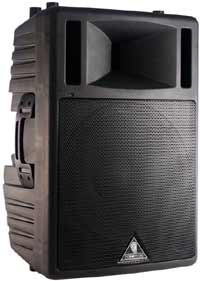
In live sound, it is a common desire to use one amplifier channel to drive more than one loudspeaker, usually for the purpose of distributing the sound more widely. But is this harmful for the amplifier or loudspeaker? And is there are limit to how many loudspeakers can be connected in this way?
The answer is in the impedance of the loudspeakers. Impedance gives a measure of how much electrical current the loudspeaker draws. Without getting too technical on electricity, look at it like this - the amplifier 'offers' a voltage to the loudspeaker. The loudspeaker draws a current, which may be lesser or greater according to the the impedance of the loudspeaker. The amplifier has no way of forcing a current into a loudspeaker other than by offering a higher voltage.
Loudspeaker designers have over the years settled on certain standard impedance ratings - 15, 8 and 4 ohms. The 15 ohm loudspeaker will draw the least current and the 4 ohm loudspeaker the most. Connected to the same amplifier, the 4 ohm loudspeaker will be loudest.
The amplifier has an output impedance too, but this is usually just a tiny fraction of an ohm. Although in the past it was common to match output and input impedances, this no longer has any relevance.
More important is the amplifier's ability to supply current. It can offer the voltage no problem, but can it live up to the loudspeaker's current demand?
You will find this information in the specification of the amplifier. Often a manufacturer will state that the amplifier will drive loads down to 2 ohms. This means that you can connect two 4 ohm loudspeakers or four 8 ohm loudspeakers in parallel. ('In parallel' means that both the terminals of each loudspeaker are connected directly to the terminals of the amplifier - the signal does not go through one loudspeaker before reaching another. The parallel connection might, confusingly, be made inside one of the speaker cabinets by means of a 'loop through' connector).
Stick within the manufacturer's ratings and all will be well.
If you tried to connect a heavier load (i.e. lower impedance, or more loudspeakers wired in parallel) to this amplifier, then there are three possibilities. If the amplifier is well designed, all should still be well, but you will find that you don't actually get a louder sound; it is shared among the speakers. Also, if the amplifier is well designed, then it may be the case that it automatically goes into a protection mode. You will not get optimum output in this mode. If the amplifier is not well designed... well, you can guess the consequences!
As a general rule, two loudspeakers per amplifier channel is usually OK.

David Mellor
David Mellor is CEO and Course Director of Audio Masterclass. David has designed courses in audio education and training since 1986 and is the publisher and principal writer of Adventures In Audio.


