
Can an electric guitar virtual instrument ever sound like a real electric guitar?
If you are reading this, then you probably have skills with guitar or keyboard, or both. But for non-guitar players, getting a good guitar sound on a recording can be quite a challenge.
If you don't play guitar, here's a hint - get a guitar player. Pay them, bribe them, make them a member of your band - do what you have to to get a real guitarist on your productions.
OK, I live in the real world too and I know that many keyboard producers want to include guitars in their music but don't want to involve anyone else in their working process. This is a similar philosophy to the great drum machine debate of the 1980s and, as we know, drum machines didn't go away - they evolved into something better such as Native Instruments Abbey Road Drums, Toontrack EZ and Superior Drummer, Steven Slate Drums and others.
So the non-guitar-playing keyboardist has similar access to guitar virtual instruments such as those from Ample Sound, Vir2, Musiclab.
But can a virtual instrument sound like a real guitar? Here I'm going to concentrate on the electric guitar, and picked articulation rather than strumming. Acoustic guitar is obviously a related issue, but my examples here will be electric. Strumming is a whole new set of issues so I'll leave that for another day.
Audio examples
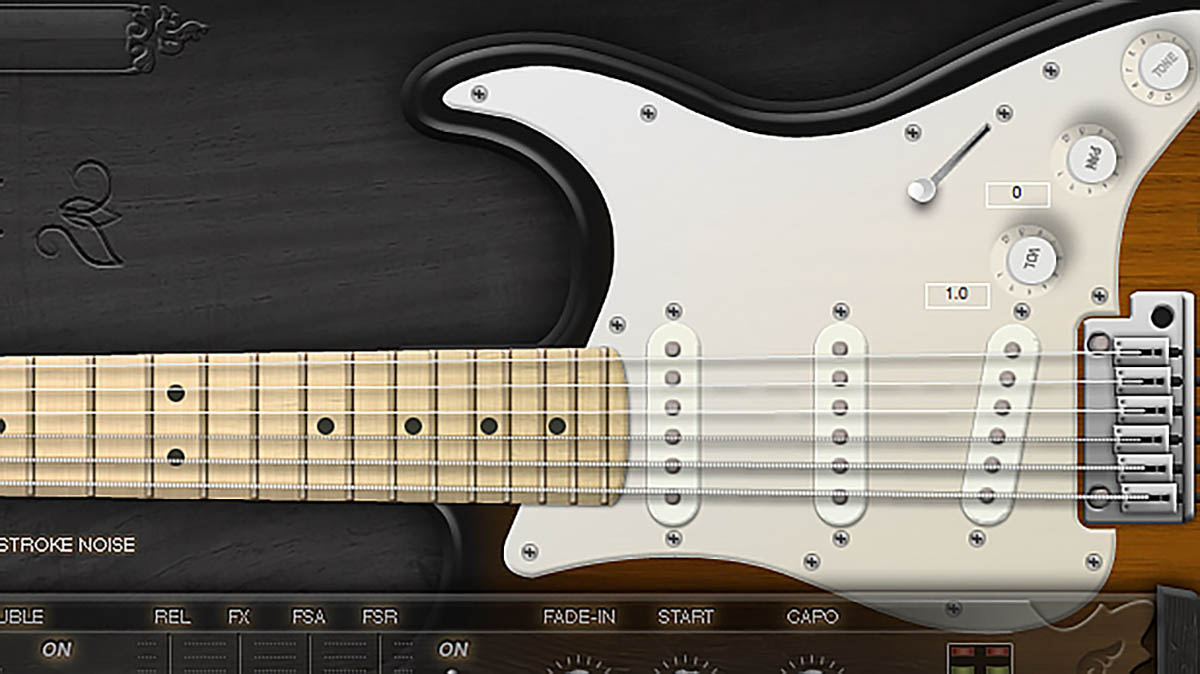
Let me dive straight in with a couple of examples. One is Ample Sound's Fender Stratocaster virtual instrument. The other is a real Fender Stratocaster. There are differences in tone, which are expected even between two examples of the same real instrument due to pickup differences, string condition and a host of other factors. But what I am interested in is whether the virtual instrument actually sounds like a real instrument played by a real guitarist. Both are processed through a plug-in chain of compression, amp simulator, EQ, delay and reverb, with exactly the same settings.
Example 1...
Example 2...
So which do you think is the real guitar? Take another listen; listen carefully, then click here to reveal the answer.
I knew the answer already obviously, and since I played both examples myself I am only too well aware which is real and which is not, and which sounds real and which does not. For me, the virtual instrument is way behind the real one in terms of musicality, expressivity and sheer humanity. It sounds like a robot guitarist.
Now this is not to say that there is anything wrong with Ample Sound's virtual instrument. It is state-of-the-art without any doubt. And if it is used to its strengths then it can sound absolutely like a real guitar. Simple note lines work well, block chords work well, simple progressions can work well. But expressive lead playing? It works quite well, but it's not the same as a real guitar. And I don't even count myself a good guitarist.
(As an aside, it is worth considering why the real example sounds more sustained than the virtual instrument, since the plug-ins were copied across with exactly the same settings, and the levels going into the compressors were RMS normalized. The answer to this is very likely that the finger vibrato in the real instrument sets off the reverb over a range of frequencies rather than just the fundamental and harmonics of the note. This also smooths over the delay effect, which seems more pronounced on the virtual guitar even though the settings are identical.)
A real guitar, and a real guitarist
At this point I think we need to consider what a real guitarist sounds like. Here's a short clip...
Wow, that is real guitar playing. The track is Free Four by Pink Floyd from their 1972 album Obscured By Clouds and the guitarist is the legendary David Gilmour. I would have to say that this is not one of Pink Floyd's best songs, but for context and to share a little bit of monetary karma with the artists I recommend a full listening on Spotify (you will need an account to hear the full track).
Done that? OK, let's move on...
Why did I choose this example? Well it probably could have been any one of a number of Gilmour's solos, but this works well to explain my point. And my point is...
If you listen to the solo note-by-note rather than as a sequence of phrases, then you will hear that every note is inflected in some way. There is hardly one note that is simply picked and left to vibrate. With his left hand, Gilmour is giving each note a different flavour of vibrato, notes are bent, there are slides both upward and downward, there are hammer-ons and pull-offs. With his right hand there is a range of expression in the picks rather than simply setting the strings into vibration. As an option, the Fender Stratocaster has a tremolo arm which offers a different texture of vibrato than the left-hand finger vibrato. Also, depending on how the bridge is set, a subtle vibrato can be created by applying pressure to the bridge with the edge of the palm.
Can a virtual instrument do this?
Yes, but only up to a point. It is common for virtual instruments to use the keyboard's modulation wheel to control vibrato, but it is always a very regular vibrato and the same on every note, other than the amount. Velocity switching can provide a certain amount of pick attack variety, but nowhere near what a real player can do. As for bends and slides, well the pitch bend wheel is useful, but getting it to sound like a real player is a near-impossible task.
I hope I don't seem to be disrespecting virtual instruments, because what they can do is amazing. And I'm not going to say that they can never sound like a real player. What I am going to say however is that if you want your virtual electric guitar instrument to sound like a real guitar, you're going to have to do some work.
That work will comprise major MIDI editing in terms of both pitch bend and modulation. You'll need to apply an individual treatment to each and every note, just like David Gilmour does. But since you're editing on a computer rather than playing an instrument you will have to apply your intellect to all of the things a real player does by instinct. Difficult, perhaps impossible to achieve perfection, but getting your work as close as you possibly can to the amazing sound of a really good guitarist will pay dividends for the overall professionalism of your production.
In summary, you can't expect a virtual instrument to sound like a real instrument being played by a real player straight out of the box. You'll have to work to craft the notes and lines into something really convincing. Take a listen to the examples again, especially the last, and see what inspiration you can take for your own work.
Settings
To finish, here are screenshots of the settings used to create the examples (click on the images to see larger versions)...


David Mellor
David Mellor is CEO and Course Director of Audio Masterclass. David has designed courses in audio education and training since 1986 and is the publisher and principal writer of Adventures In Audio.


