
Audio compressor controls: The ratio control
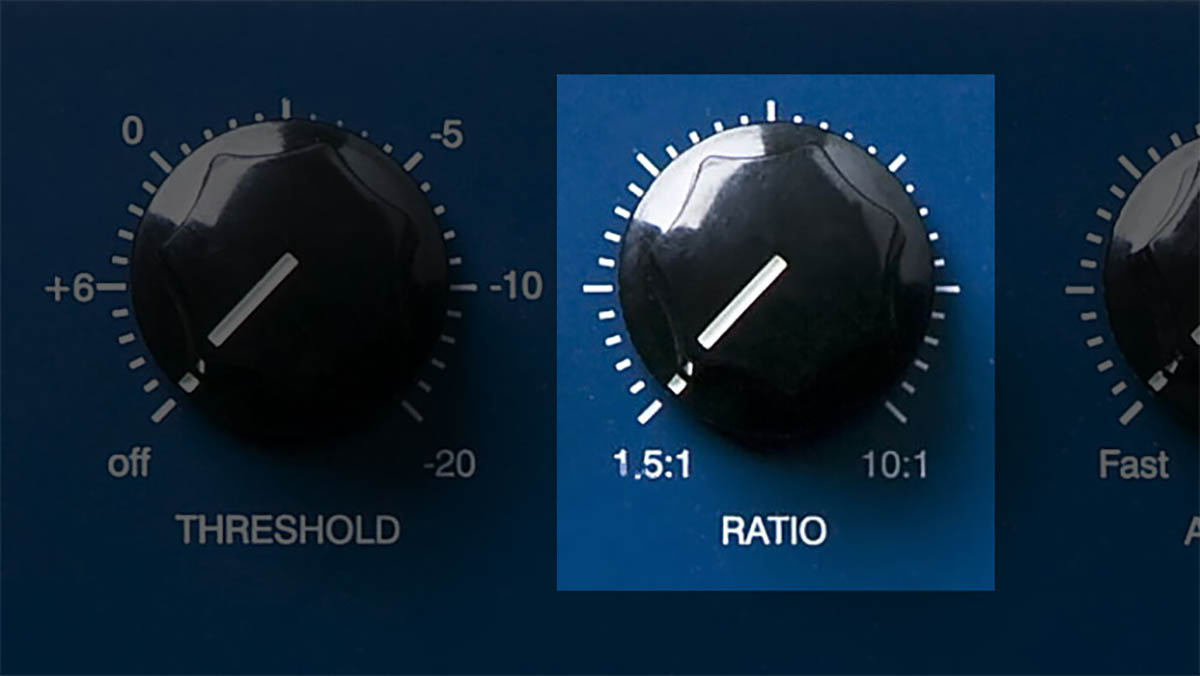
In this series, we look at all of the important controls of the audio compressor, starting with the ratio control.
An audio compressor, whether hardware or plug-in, has a number of controllable parameters. Usually these...
- Ratio
- Threshold
- Attack
- Release
- Make-up gain (or gain make-up)
- Stereo link
(Some compressors omit one or more of these controls or call them by different names.)
In this article, I'll look at the ratio control and assume that all of the other controls are set to values that would be useful for a vocal recording.
The process of compression reduces the level of loud sections of the audio signal, while leaving lower levels unchanged.
The ratio control is calibrated in simple mathematical ratios from around 1:1 to around 20:1. Higher ratios are possible. Lower ratios are also possible, but that would be an expander, not a compressor.
A ratio of 1:1 means no change. What comes out of the compressor is exactly the same as what went in.
This doesn't sound very useful. However if you have a 'character' compressor, like one that has or emulates vacuum tube circuitry, you might want the warmth that it adds to the signal without any compression.
A ratio of 2:1 means that if the input signal level rises by 6 decibels, the output level rises by only 3 dB. If the input level rises by 20 dB, then the output rises by 10 dB.
Similarly, a ratio of 10:1 means that if the input rises by 20 dB, the output will rise by only 2 dB.
There is an important point here that compression only takes place when the signal is above a certain level, which is set by the threshold control. The threshold control will be explained in detail in a separate article.
So to summarize, the compressor lowers the level of signals that are above the threshold level, at a ratio set by the ratio control.
What does it sound like?
If the ratio is set to 1:1, if available, then the output signal will sound exactly the same as the input signal, plus any warmth added if the compressor is a 'character' model.
If the ratio is set to 1.5:1, the compression effect can be useful, particularly if a low threshold is set, but difficult to detect. In other words, the signal is compressed without it sounding obviously compressed.
At a ratio of 2:1, the compression effect is greater, and on the point where care has to be taken in setting the other controls if the compression is to be subjectively undetectable, other than by comparing the input and output directly.
A ratio of 3:1 or 4:1 is useful on vocals, to keep the dynamic range under control without sounding too compressed.
A ratio of 8:1 will almost certainly sound compressed, and if you use a ratio as high as this it is likely that you want the sound of compression, which can be attractive in its own right in an appropriate context.
Ratios of 10:1 or higher are used when you want to achieve a highly compressed sound.
A ratio of 20:1 or higher, if available, can be used for limiting, which is to control peak levels with a high threshold so that only the peaks are reduced in level and low to medium levels are unaffected.
In summary, understanding and careful setting of the ratio control is necessary to get the best out of the compressor. An understanding of all of the other major controls is also essential.
One more point - If your compressor doesn't have a ratio control then it can still work just fine. There will be more on this in another article. However, your outboard rack or plug-in collection isn't really complete until you have a compressor that possesses the standard controls for ratio, threshold, attack, release and make-up gain. (Stereo link too for a 2-channel hardware compressor. A plug-in compressor will normally stereo link automatically when inserted into a stereo track.)

David Mellor
David Mellor is CEO and Course Director of Audio Masterclass. David has designed courses in audio education and training since 1986 and is the publisher and principal writer of Adventures In Audio.


