
A very unusual tape recorder used for mastering
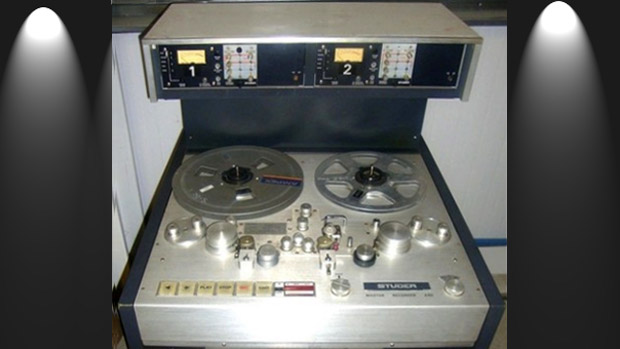
At the time of writing (June 13, 2012), this tape recorder is up for auction on Ebay. It is a Studer A80 and, as analog tape recorders go, this is one of the very best. But this isn't a normal A80, it is the mastering version. So the question is, why is there a special mastering version, and what makes it different from a normal A80?
If you look closely at this pic, you will see that the heads are arranged differently to a normal tape recorder...
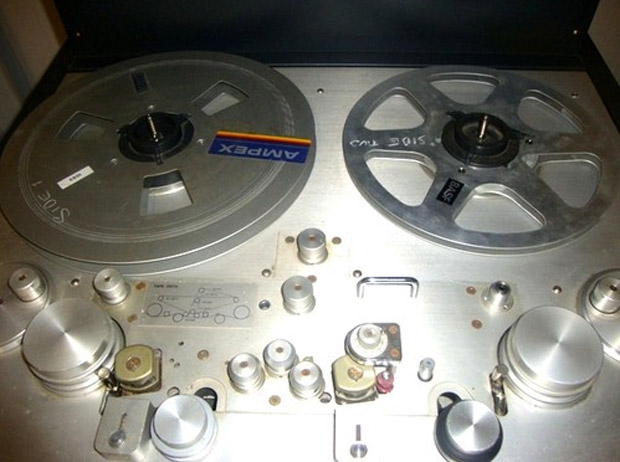
Usually, you would expect to see three heads - erase, record and play - set very close together underneath a head cover that makes everything look neat and tidy. But here there are two playback heads, separated quite widely.
So this machine can't even record, so it isn't even a tape recorder - it is a tape playback machine. So how does that make it suitable for mastering?
The answer is that this machine was used for mastering to vinyl. It is only ever used to play back signal to a vinyl cutting lathe. It is not capable of recording and that never was the intention of the machine.
So now the question arises why a special version of the A80 was desirable for mastering? Why wouldn't a standard A80 do?
The answer to this is that to maximize the duration of playback of each side of a vinyl record, the turns of the groove should be spaced so that they never take up any more width than necessary. Loud signals make the groove wiggle a lot. For quiet signals the groove is much more nearly a smooth curve. Lathes were designed so that they could automatically modify the pitch of the groove according to the level of the signal. However, since a quiet section in one turn of the groove might be followed by a loud section in the next, the lathe had to be able to 'look into the future' to see what is coming next.
This is the purpose of the second 'preview' playback head on the left, which sends signal to the lathe's control mechanism a little ahead of the signal sent to the lathe's cutter head. The extra tape guides are there to extend the time interval between the preview head and the main playback head. The tape is looped around these heads according to the diagram attached to the top plate of the machine.
Of course you could say, "Why not use a normal tape recorder and delay the signal to the lathe's cutter head digitally?"
Tell this to a vinyl junkie and see what happens...

David Mellor
David Mellor is CEO and Course Director of Audio Masterclass. David has designed courses in audio education and training since 1986 and is the publisher and principal writer of Adventures In Audio.


