
Distortion in analog recording
Distortion in audio is like a curved funfair mirror. A flat mirror reflects things as they are. In technical terms, we would say that it has a 'linear transfer function' 'linear' meaning, 'a straight line'.
A funfair mirror is curved, therefore its surface is not flat nor straight, and therefore it has a non-linear transfer function. The reflection is distorted and not a true image of the person standing in front of the mirror.
All audio systems bend the waveform of the signal to a degree. Once again, we say that they have a non-linear transfer function, although digital or purely electronic systems are so nearly linear that very few people would ever notice. This non-linearity causes the phenomenon we know as distortion.
Distortion is a bending of the waveform. It leads to additional frequencies being produced that were not present in the original signal. This audibly changes the sound, in most cases for the worse.
Certain systems produce distortion that is easily audible:
- Microphones, with high level signals
- Loudspeakers, most prominently with signals that are in the upper range of the woofer
- Horn loudspeakers, where the air in the throat of the horn is compressed to an extreme degree
- Vinyl record players, where it is not always possible to maintain perfect contact between the stylus and the walls of the groove
- Analog tape recorders.
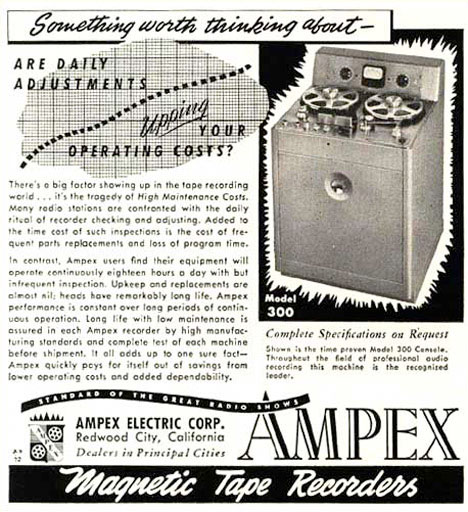
The recording medium of an analog tape recorder is magnetic tape. The electrical input signal is converted to a magnetic signal on the tape so that it may be stored.
Magnetic materials do not respond linearly to a magnetizing force. For a small magnetizing force, they do not become magnetized very strongly. However for a larger magnetizing force, they respond well. So for small magnetizing forces, there is a region where the magnetic medium does not respond linearly, although above these levels, the response is fairly linear. The problem is that the waveform passes through near-zero levels on every cycle, thus the inherent sound of an analog magnetic tape recording is very distorted.
As a consequence of this, although tape recording was invented in the early years of the 20th Century, its high level of distortion meant that it was inadequate for anything other than use as a dictation machine. Certainly it was totally unusable for music.
The invention that transformed the analog tape recorder from a dictation machine to a music recording device, during the 1940s, was AC bias.
Since the response of tape to a small magnetizing force is very small, and the linear region of the response only starts at higher magnetic force levels, a constant supporting magnetic force, or bias, is used to overcome this initial resistance. Prior to AC bias, DC bias was used courtesy of a simple permanent magnet.
However, considerable distortion remained. AC bias uses a high frequency (~100 kHz) sine wave signal mixed in with the audio signal to 'help' the audio signal get into the linear region which is relatively distortion-free.
This happens inside the recorder and no intervention is required on the part of the user. However the level of the bias signal has to be set correctly for optimum results. In traditional recording, this is the job of the recording engineer before the session starts.
It has to be said that line up is an exacting procedure and many modern recording engineers have so much else to think about (their digital transfers!) that line-up is better left to specialists.
Despite AC bias, analog recording produces a significant amount of distortion. The higher the level you attempt to record on the tape, the more the distortion.
It isn't like an amplifier or digital recorder where the signal is clean right up to 0 dBFS, then harsh clipping takes place. The distortion increases gradually from barely perceptible to downright unpleasant.
Most analog recordings peak at a level that will produce around 1% distortion, which is very high compared to any other type of equipment. At 3%, most engineers will be thinking about backing off. More is unacceptable.
It may not sound promising to use a medium that produces so much distortion, but the fact is that it actually sounds quite pleasant! It is also different in character than vacuum tube (valve) distortion so it is an additional tool in the recording engineer's toolkit.
There are digital simulations of analog tape distortion available. However, the tape recording medium is more complex than this and there are significant other artefacts to further complicate the issue (or one might say make the sound more complex, and perhaps more interesting to the ear?).

David Mellor
David Mellor is CEO and Course Director of Audio Masterclass. David has designed courses in audio education and training since 1986 and is the publisher and principal writer of Adventures In Audio.


