
Beyond the Faulkner phased array - the 'Mellor Quad'
One of the problems in recording an orchestra is that the main stereo pair of microphones must be placed closer than the natural listening distance because of their over-sensitivity to reverberation in the auditorium compared to the human ear/brain system. This favors the front rows of instruments at the expense of the rear, and the result is an unnatural overall sound. This is usually cured by introducing additional microphones, but this inevitably also introduces more 'fog' into the sound and less clarity.
So if a stereo technique could be developed that would allow the main stereo pair of microphones to have a narrower angle of coverage, then they could be placed further away, closer to the natural listening position, for a natural perspective.
One solution to this has been employed by the respected British recording engineer Tony Faulkner, in the form of the 'Faulkner phased array', as it is commonly known.
In this, two figure-of-eight microphones are placed parallel to each other spaced apart by 200 mm.
The figure-of-eight microphone indeed has the tightest directional pattern of any of microphone type (other than interference tube or parabolic reflector mics, where sound quality suffers significantly). The drawback is that there is an equal pickup to the rear, but if the acoustics of the auditorium are good then this should not be a problem.
I have tried the Faulkner phased array myself, and although I don't seem to get results quite as good as the originator, they are certainly interesting and the technique is worth having in one's repertoire of mic techniques.
However, I would ideally like to place the mics even further back, which would require a yet tighter directivity pattern.
To do this I have borrowed a technique from radio astronomy. A radio telescope is simply a large satellite dish, picking up radio signals from the universe rather than satellite TV. Bigger is better as the telescope can be more tightly focused and resolve finer detail in the sky.
However, for the ultimate precision in radio astronomy, data from two telescopes can be synchronized, effectively making a telescope of size equal to the distance between the two individual telescopes.
You can do this with microphones too...
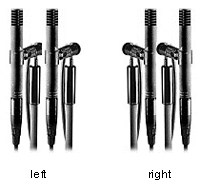
Here, I recommend two figure-of-eight microphones perchannel all facing in parallel towards the orchestra. The inner microphonesshould be spaced apart by 200 mm as in the Faulkner phased array. The pairs ofmicrophones for each channel can be spaced as widely as you need to attain greaterdirectivity. Up to around 300 mm seems practical. Both microphones for the leftchannel are mixed together at equal levels. Same for the right channel.
At this point more data is needed to prove the value of this system. If you have the opportunity to try it out, please let me know how you get on.
Perhaps this system will come to be known as the 'Mellor Quad'?

David Mellor
David Mellor is CEO and Course Director of Audio Masterclass. David has designed courses in audio education and training since 1986 and is the publisher and principal writer of Adventures In Audio.


